

Chapter 2
02Setting a Vision for My Life
As the days passed I felt small changes in my life thanks to the creativity appearing in every part of it. But despite the growing contentment, I realised I needed clearer direction; it was not enough to live day by day. I wanted a comprehensive vision for my life, a goal to move me.
One night I sat in my dimly lit study with pen and notebook and decided to define a vision for my life. I knew it would not be clear from the start, but it would be a compass. I wrote the questions in my head: “What makes me wake up excited every morning?
What do I want to achieve in the next five years? How do I want people to remember me in twenty years? And with what do I wish to meet Allah?”
Why You Need a Vision
- Clarity: Knowing what you want gives you a clear sense of purpose.
- Focus: A vision helps you order your priorities.
- Motivation: When challenges arise, your vision gives you the drive to keep going.
- Direction: It keeps you on track even when life surprises you.
I thought about my past achievements and what had made me proud, and remembered the moments I felt I had contributed something of value. I also remembered times of idleness and feeling lost, and knew that avoiding them required greater clarity of direction.
Then I divided my life into areas: my relationship with Allah, work, relationships, health and emotion, and asked what my vision was for each. At work I wanted to be influential, helping people develop themselves and discover their abilities.
In relationships I wanted deep, lasting bonds built on support and communication.
In health I decided to care for body and soul through regular exercise and attention to my psychological and emotional wellbeing. I did not want success at work or the affection of others alone, but a balanced life with happiness and ease in every part of it.
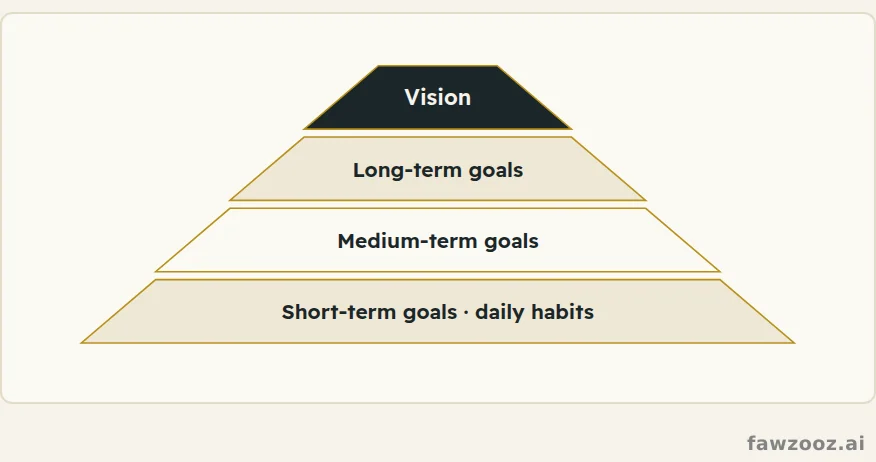
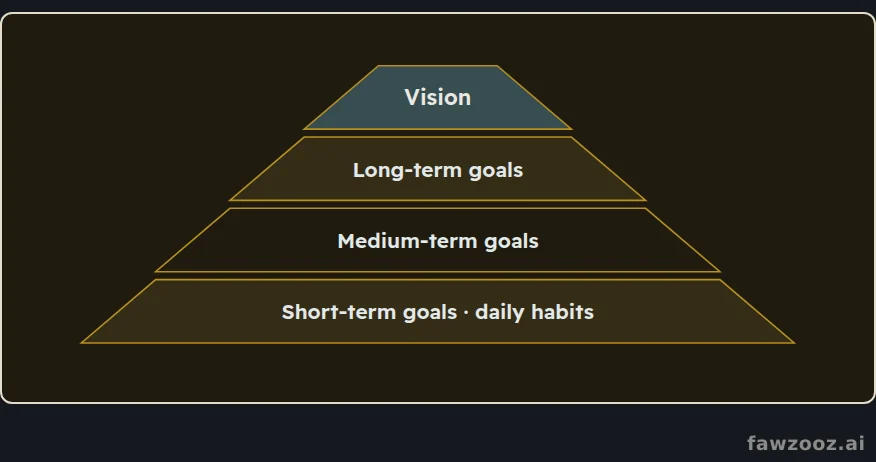
Text in this figure
Vision · Long-term goals · Medium-term goals · Short-term goals · daily habits · Figure 20
Exercise: Write Your Vision Statement
First, list your core values (such as faith, creativity, family, security, compassion). Second, imagine your life in 5, 10 and 20 years: where are you, what have you achieved, what are your relationships like? Third, combine the values and the picture into one short sentence. Fourth, review it regularly and refine it as you grow.
At the bottom of the page I wrote: “I want to live a life full of creativity and balance, to be someone who helps change others’ lives for the better, and to live with inner peace and ease, in the pleasure of Allah.”
This sentence was the seed of my new vision. It was not final, but it was a starting point to guide me forward and help me make decisions with clarity and confidence.
From Vision to Goals
- Long-term goals: Big goals that take years, such as launching a project that serves the community within five years.
- Medium-term goals: Steps that lead to the long-term goals, such as completing a business plan within the year.
- Short-term goals: Daily or weekly actions that keep you on track, such as researching the market this week or meeting an adviser.
Prototyping Your Life
One principle of Fawzooz is to approach life with a designer’s mindset: treating my future as a prototype I can test and refine. I do not need the full picture to begin.
If my vision is to travel, I start with a short trip nearby; if it is changing careers, I volunteer in the field or take a course; if it is writing a book, I begin with short articles.
Then I gather what the experience taught me and adjust my vision.
A vision that conflicts with your values will leave you feeling disconnected however successful you are; so weigh your vision against your values, and your values against the Shari‘ah.
In Today’s World
Today’s abundance of choice, from courses and jobs to content, makes distraction easier than ever. A written vision is your filter: you can calmly say “no” to every opportunity that does not serve it.
Tip: use ← → to move between sections.