

Chapter 1
01Returning to Prayer
After those moments of prayer in the mosque I felt a real comfort I had not known for a long time. It was not the temporary relief I used to find when escaping reality, but a comfort from a deep place inside me, from the certainty that Allah hears me and knows what I am going through.
Those moments were a turning point, and I began asking myself: how far had I drifted from my daily worship? And what had that done to my soul?
When I returned home that night I thought deeply about my relationship with prayer.
It had been a core part of my life since childhood, but in recent years it had become another item on my daily task list, performed without truly feeling it, a routine whose meanings I did not reflect on and whose moments I did not live.
So I made a decision: to return to prayer with a new spirit, not just performing it on time but treating it as a connection with Allah and a path to the peace I was seeking, living every prayer as a private meeting with Allah that opens my heart and reorders my thoughts and priorities.
The next day I woke to the call to Fajr and rose for prayer with real longing. I made ablution slowly, feeling the water on my skin as if it were washing away my worries.
When I stood to pray I did not settle for the movements; I tried to live every word of Al-Fatihah: “All praise is for Allah, Lord of the worlds,” said from my heart, grateful for every blessing despite the difficulties.
With every rak‘ah I felt nearer, as if prayer had become the rope connecting me to the heavens. After the salam I stayed in my place for a long time in supplication, not only with the requests of daily life, but with a prayer from the heart asking for guidance and tranquillity.
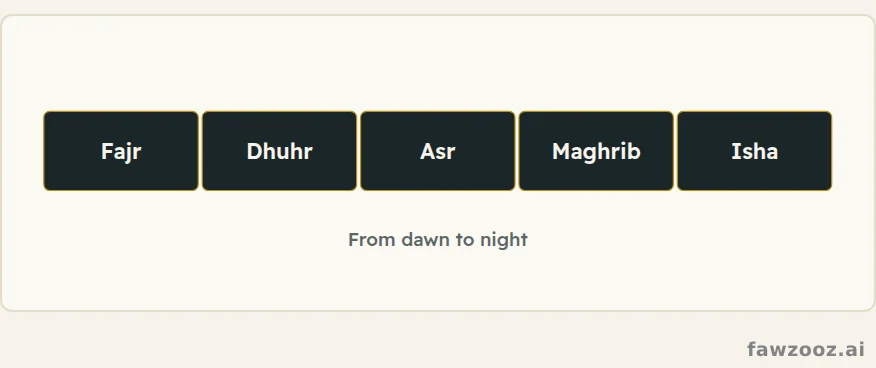
Text in this figure
Fajr · Dhuhr · Asr · Maghrib · Isha · From dawn to night · Figure 9
Over the following days prayer became my path to psychological balance as well; each one a chance to stop and reflect, reminding me what truly matters and giving me strength to face challenges. Life was not free of difficulty, but I felt I held the strongest weapon to face anything.
The spirit of prayer spread into the rest of my day: at work I was calmer and more patient, and in my relationships more understanding and supportive, feeling that Allah was with me at every step and that each challenge was part of a test of my faith and patience.
The prayer I used to rush became a source of tranquillity and strength. I made sure no prayer passed without living its details, even in times of pressure and hard work; it was my refuge, where I reordered my thoughts and drew strength from Allah.
My return to prayer was not a return to a religious routine, but a return to Allah and to myself. I realised prayer is not a burden to be endured but a blessing and a chance to renew the soul, and this was only the beginning.
“Give us rest through it, O Bilal”: prayer was a rest, not a burden to be rested from.
In Today’s World
The phone is the greatest thief of khushu‘ today. Create a silent zone for prayer: switch to do-not-disturb before the adhan and keep the device away from where you pray. Prayer-time and qiblah apps are a blessing when they serve the prayer, not when they become a door for a notification that interrupts it.
Tip: use ← → to move between sections.