

Chapter 4
04Dealing with Intense Emotions
In the months that followed I became more aware of my thoughts and better at challenging those that held me back. Yet there were moments when strong emotions, intense anger or sadness, took over and made me feel as if all my progress was vanishing.
CBT helped with my thoughts, but what about the deep emotions that flared suddenly and pushed me into actions I regretted?
One night, after a long and exhausting day, I was overcome by an outburst of anger with no clear reason. Everything seemed to be collapsing around me and I could not control my emotions. That was when I realised I needed another tool.
I discovered dialectical behaviour therapy (DBT), which focuses on regulating and accepting emotions rather than only trying to control them.
While CBT relies on changing thoughts, DBT is about accepting emotions and finding healthy ways to deal with them.
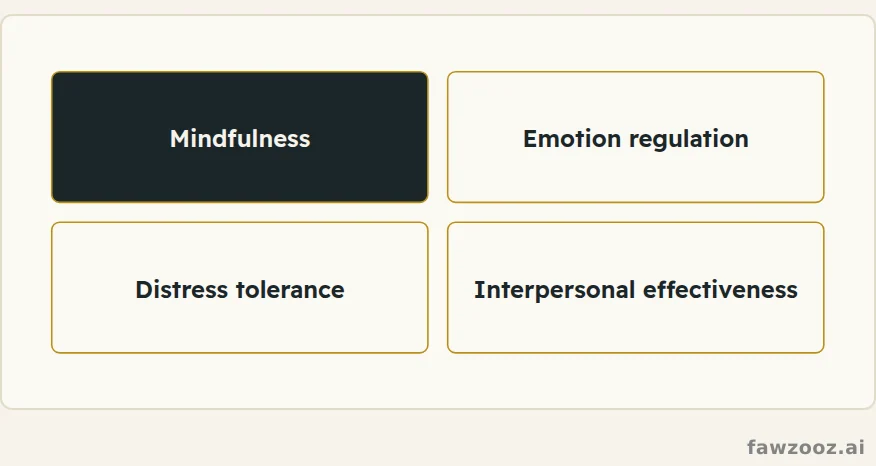
Text in this figure
Mindfulness · Emotion regulation · Distress tolerance · Interpersonal effectiveness · Figure 5
Mindfulness: Accepting the Present Moment
The first lesson was mindfulness: being present in the moment and accepting my feelings without judging them or trying to change them at once. I learned that resisting or ignoring emotions makes them stronger, while accepting them is the first step to managing them.
So I began each morning with a short session, sitting quietly and focusing on my breath, letting thoughts and feelings appear without resistance.
I realised that emotions, however intense, pass with time when treated gently. I found a root for this in our own tradition, muraqabah: a heart that is present, aware that Allah sees it.
Emotion Regulation: Handling Big Feelings
Acceptance alone was not enough; I needed skills to calm big emotions before they overwhelmed me. One day I had to give an important presentation, and the tension rose as the moment approached: my heart raced and negative thoughts crept in.
I used deep breathing: a slow breath in through the nose and out through the mouth.
After a few breaths the tension eased. The feelings did not disappear completely, but they no longer controlled me, and I regained my calm and finished the presentation with confidence.
Distress Tolerance Skills
Life has moments of real crisis, at work, in relationships or in personal life. One of mine came when I received shocking news from a family member; I broke down emotionally and could not think clearly. That was the real test of what I had learned.
DBT has skills designed for situations beyond our capacity to endure, among them temporary distraction: instead of diving straight into my feelings, I do something simple to shift my attention for a short while.
I went for a walk outside, focusing on the sound of my steps and the wind, giving myself space to breathe before returning to the crisis. When I came back I was steadier; the problem was not solved, but I had regained control of my emotions and handled the situation more rationally.
Effective Communication: Building Healthy Relationships
I knew one cause of my constant tension was my inability to express my feelings clearly; I suppressed them until they exploded later. So I practised emotional validation: expressing my feelings calmly and clearly instead of exploding.
A close friend had been doing something that bothered me for some time, so I sat with him and said: “I want to tell you that I feel frustrated when this happens.
I value our friendship, but I need us to talk about it.” It was a completely different conversation from what I was used to; instead of conflict, I found my friend ready to listen and understand.
Over time DBT became part of my life; I used mindfulness and emotion regulation regularly at work and at home. Big emotions did not disappear, but they no longer swept me away as before.
I became more aware, calmer and better able to meet life’s challenges with balance. I had not reached perfection, but I knew I was on the right path, a path full of learning and hope.
In Today’s World
From the prophetic guidance on calming anger: “If one of you becomes angry while standing, let him sit down; if the anger leaves him, well and good, otherwise let him lie down,” along with seeking refuge in Allah from Satan, and making ablution. These are distress-tolerance skills that preceded therapy manuals by centuries: they change the body’s posture and break the momentum of the moment.
Tip: use ← → to move between sections.