

Chapter 2
02Discovering Emotional Intelligence
I woke the next morning feeling different, as if the weight on my chest had begun to lift. It was not a fast change, but there was a strange sense of optimism. I knew things would not change overnight, so I decided to take one small step forward.
I realised that the key to change was understanding my emotions, something I had never given importance to.
I read everything I could about emotional intelligence, and it turned out to be a map for understanding myself and how I deal with others, made of five core components.
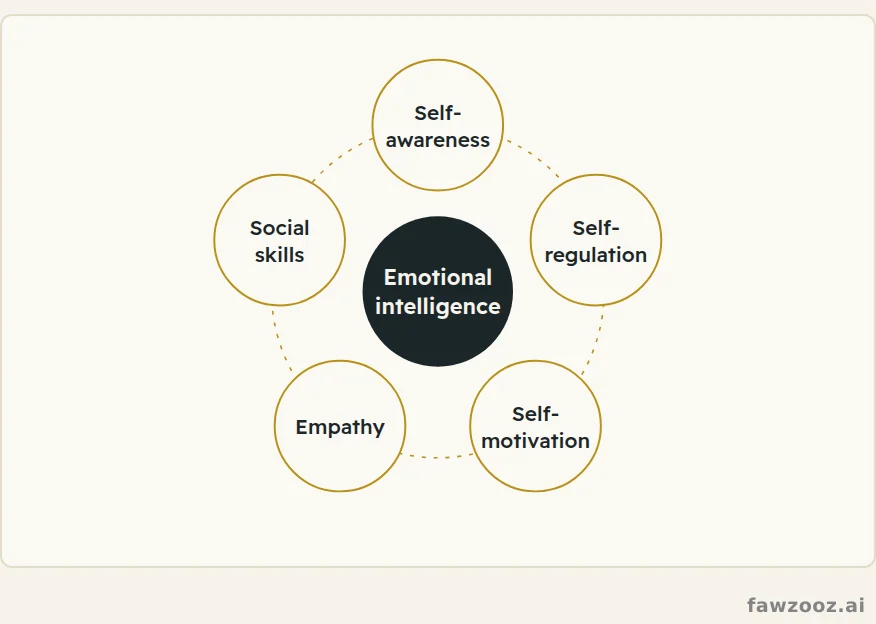
Text in this figure
Emotional · intelligence · Self- · awareness · Self- · regulation · Self- · motivation · Empathy · Social · skills · Figure 3
Self-Awareness
This was the first point that caught my attention. I knew when I was angry or sad, but emotional awareness goes deeper: understanding the real causes behind feelings and how they shape behaviour.
I sat alone analysing the events of the previous day. What pushed me to explode? Was it really the criticism, or had other feelings been accumulating inside me for a long time?
I discovered something new: my sense of failure was the real engine of my anger. The problem was not the criticism but my fear of appearing incompetent. So I decided to face my feelings instead of ignoring them; I did not yet know how, but acknowledging them was the first step.
Self-Regulation
It is easy to admit anger or sadness, but how do I stop those feelings from taking over? I learned the idea of emotional regulation: directing emotions in a positive way without suppressing them or letting them control my behaviour. I began with a simple experiment.
The next time I felt angry or sad I would take a deep breath and pause for a moment. I would not react immediately but give myself a chance to think before acting. It was a small test, but a step towards freedom from emotional chaos.
Self-Motivation
Controlling emotions was not enough. Self-motivation is an important part of emotional intelligence: driving yourself towards your goals even when conditions are not ideal.
So every day I set myself small, simple goals: stay calm in the meeting, listen to colleagues instead of replying instantly, and stay aware of my feelings.
Every goal I achieved gave me a sense of accomplishment.
Empathy
Empathy was the hardest component for me. I rarely thought about how my emotions affected others and tended to react instantly without considering those around me. But I began to see the importance of understanding their points of view and putting myself in their place.
I tried listening seriously to the colleague who had criticised me instead of answering him harshly, and discovered he had not been trying to crush me but to improve the project.
That moment opened my eyes: the problem was not the criticism itself but the way I received it.
Social Skills
Finally I realised that social skills play a large role in building healthy relationships. I learned to interact effectively with colleagues, friends and family, using clear and courteous communication instead of instant emotional reactions.
Over the following weeks my life began to return to some balance. I learned that emotions are not an enemy to be destroyed but part of my human nature that simply needs understanding and direction.
Every step brought me closer to my larger goal: a more aware and calmer life in which my emotions become a tool for growth rather than an obstacle.
In Today’s World
AI tools can now draft our messages and soften our words, but they cannot feel on our behalf. Self-awareness and empathy remain human responsibilities. In the prophetic teaching: “The strong man is not the one who wrestles others down; the strong man is the one who controls himself when angry.”
Tip: use ← → to move between sections.