

Chapter 7
07Achieving Financial Security
After reaching emotional and spiritual balance I felt inner stability, but another area needed attention: financial security. My projects were going well, but I realised financial stability requires careful planning and a clear strategy.
One evening I sat with my notebook thinking about my finances.
Money was not my goal in life, but it is one of the pillars for achieving my dreams and ambitions, and in Islam wealth is a trust and a means: “How excellent is righteous wealth for a righteous man.”
So I decided to take practical steps towards halal financial security that would free me to focus on creativity and innovation.
Text in this figure
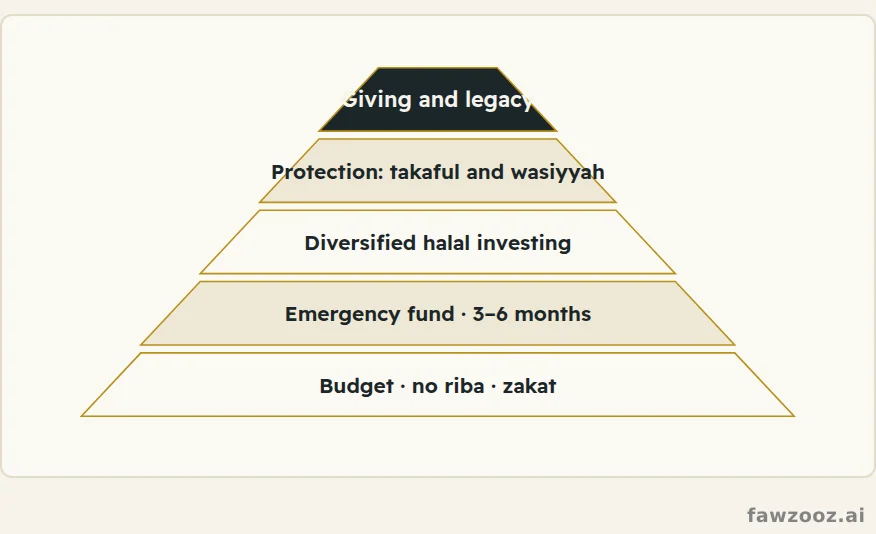
Giving and legacy · Protection: takaful and wasiyyah · Diversified halal investing · Emergency fund · 3–6 months · Budget · no riba · zakat · Figure 26
Why Design Financial Security?
- Peace of mind: A solid financial base reduces anxiety about the future so you can focus on personal and creative growth.
- Freedom to create: Stability gives you the freedom to explore opportunities and pursue your passions without constant worry about money.
- Support for your goals: It lets you invest in your goals: a project, education, or a good legacy for your family.
Step One: A Clear Financial Blueprint
I began with a clear financial plan, setting long-term goals such as saving to invest in new projects and securing my personal and family needs. Financial planning does not only protect against risk; it gives more freedom in professional and personal decisions.
Then I drew up a precise monthly budget of income and expenses, tracked the details, and identified what could be cut or redirected to something more beneficial, to improve my standard of living without constant worry about money.
Exercise: Your Financial Blueprint
Write your financial goals for one, five and ten years, and break each into practical steps, such as a monthly saving amount or a halal investment plan. Make zakat and sadaqah a fixed line in the plan, not whatever is left at the end of the month.
Step Two: Smart Financial Habits
- Pay yourself first: Set aside a percentage of income for saving before paying bills and expenses, and make it automatic.
- Live below your means: Avoid lifestyle inflation as income rises; Allah does not love those who are extravagant.
- Track your spending: Use budgeting tools to see where your money goes and what you can do without.
- Clear debt and avoid riba: Pay off debts promptly and beware of interest-bearing credit cards and loans; riba is forbidden and its blessing is wiped away: “Allah destroys riba and gives increase for charities.” (2:276)
Step Three: An Emergency Fund
I realised the importance of preparing for possible financial crises, so I built an emergency fund to cover my personal and professional expenses for several months if the unexpected happened. The usual target is three to six months of living costs, in an easily accessible, non-interest account.
If the target seems large, start with a small amount and grow it gradually, with an automatic monthly transfer. This step gave me reassurance and the freedom to make bolder professional decisions without fearing for my financial security.
Step Four: Investing Wisely and Halal
Once the budget was in place I thought about growing my savings; I did not want money to sit idle, for wealth grows through halal trade, not through riba.
I chose moderate-risk investments rather than high-risk ones, took stakes in some start-ups with creative ideas that matched my values and ambitions, and learned to follow the markets continually to improve my decisions.
The investment rules I committed to:
- Start early: The earlier you start, the more time your wealth has to grow through halal profit, even with small amounts.
- Diversify: Spread your money across Shari‘ah-compliant assets, such as screened equities, sukuk, real estate and partnerships, to reduce risk.
- Verify compliance: Choose funds and platforms supervised by a Shari‘ah board, and stay away from riba, gharar, gambling and speculative schemes.
- Consult experts: If you are new to investing, seek a trusted adviser who knows the rulings of Islamic transactions and understands your goals and risk tolerance.
Step Five: Protect Your Financial Future
- Takaful: Protect yourself and your family with health cover and takaful based on mutual cooperation and donation, in place of conventional insurance involving gharar.
- A wasiyyah according to the Shari‘ah: Write your will within one third and not for an heir, record your debts and rights, and let inheritance be divided as Allah ordained; it protects your family from dispute. “It is not right for a Muslim who has something to bequeath to spend two nights without his will written down with him.”
- Review regularly: Review your cover, will and plan whenever your circumstances change.
Step Six: A Healthy Money Mindset
Financial security does not rest on practical steps alone, but on a healthy relationship with money: seeing it as a tool that serves your goals and values, not a source of anxiety.
Move from scarcity to abundance and contentment with what Allah has apportioned, free yourself from attachment to appearances and consumption, put your money into experiences, growth and meaningful goals, and thank Allah for what He has provided: “Richness is not having many possessions; true richness is the richness of the soul.”
Balancing Money and Life
Over time I felt the effect of planning on my life. Money was no longer a constant source of worry but a means to my goals, and I felt an independence that gave me freedom of decision, so I could devote myself to what really mattered: creativity and growth.
It did not happen overnight, but continuous planning and commitment get you there, by Allah’s leave. And I took care not to forget the values I had learned; money is not the goal but a means to a life full of meaning.
I set aside part of my income to support creative projects, help those around me, and back charities and initiatives that fit my values; giving is an inseparable part of financial success, and using money to change others’ lives is what gives me a real sense of achievement.
Blessing lies not in the amount of wealth, but in its being halal, in spending it well, and in giving Allah His due from it.
In Today’s World
“Buy now, pay later” apps, cryptocurrencies and rapid trading on the phone are everywhere. Before any new financial product ask: does it carry interest or interest-based late fees? Does it involve gharar or gambling? Ask scholars and recognised Shari‘ah boards; the ease of a tap does not make the forbidden permissible.
Tip: use ← → to move between sections.