

Chapter 4
04Designing Work-Life Balance
Despite the progress I had made in building a creative mindset, another area needed attention: the balance between work and life. Immersed in my new project and its intense demands, things began slipping out of control: long hours, little time for family and friends, and growing exhaustion.
One night I came home drained after a long day of meetings and sat on the sofa trying to relax, but my mind would not stop thinking about work details and unfinished tasks. That was when I realised I urgently needed to restore balance.
Thinking About Priorities
I took a few days off to think, sat with my notebook and assessed every area of my life, writing: “What are my priorities? What matters most to me?”
Work matters, especially with the success beginning to come, but I realised balance is not a luxury; it is a necessity for staying productive and happy in the long run, and I had to find enough time for my family, friends and mental and physical health.
Balance does not mean dividing time equally, but harmony between the two, and it is a continuous process, not a fixed goal.
- Integration, not separation: When your work fits your values it becomes a support for your life, not its rival.
- Flexibility: Life is unpredictable; be ready to adjust your plan when needed.
- Prioritisation: Not everything is equally important; begin with what matters most.
Planning for Balance
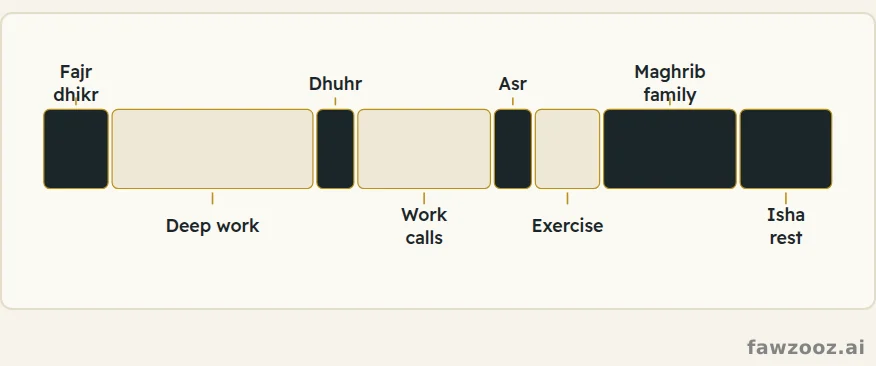
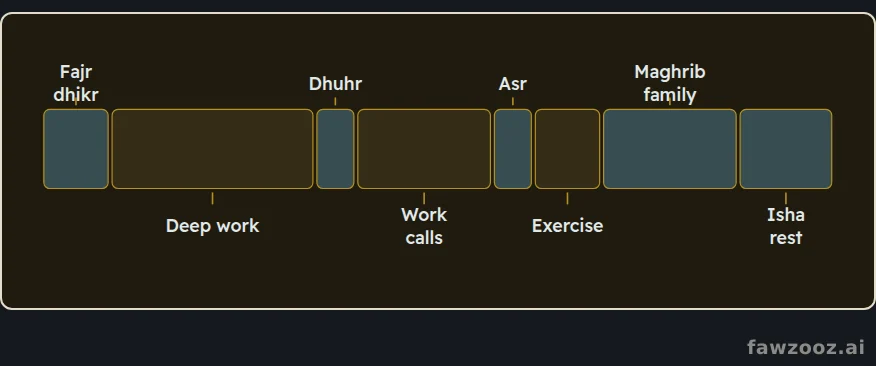
I made a plan to divide my time better: I defined clear working hours and committed to a fixed finishing time each day so work would not run late into the night, and set aside days each week completely free of work for family and friends.
I cared for my physical health by exercising regularly, and set time for reflection and remembrance to calm my mind; the creative mind needs rest as much as challenge, and rest is part of the creative process.
Text in this figure
Fajr · dhikr · Deep work · Dhuhr · Work · calls · Asr · Exercise · Maghrib · family · Isha · rest · Figure 23
- Time blocking: Set specific blocks of time for work, family, exercise, worship and personal projects, and let the five daily prayers be the pillars the day is built around.
- The 80/20 rule (Pareto principle): Roughly 80% of results come from 20% of effort; focus on the highest-impact tasks in your work and your life.
- The Pomodoro technique: Work for 25 focused minutes, then take a short break; it keeps your attention and guards against burnout.
Exercise: Design Your Ideal Day
List the day’s priorities (work, worship, exercise, family, personal projects, rest). Then divide the day into realistic time blocks around the prayer times, and leave unplanned space for the unexpected and for relaxation.
The Challenges of Applying Balance
It was not easy at first; I sometimes felt guilty stepping away from work, especially with deadlines and unfinished tasks. But I knew my commitment to balance was the key to sustaining my success.
On a day when the pressure was mounting I went out with friends away from the office; at first I worried about the lost time, then felt rested and refreshed, and realised these moments give me the energy to return to work with strength and focus.
Positive Change
As the weeks passed I felt the change. Work was no longer my whole life but part of a balanced whole that included care for myself, my family and my friends.
I noticed this balance made me more productive at work and more creative in my projects, and that the relationships I had neglected began to improve.
Balance was not always easy, but I realised that the more I invested in my personal life, the more every other area improved, work included. I understood that real success does not come from hard work alone, but from balance between work and life.
In Today’s World
Hybrid work and the smartphone have made the office present everywhere. Agree “response hours” with your team, turn off work notifications after a set time, and make your day off a real day off. A short nap, which is from the Sunnah, renews the energy of the afternoon.
Tip: use ← → to move between sections.