

Chapter 3
03Confronting Negative Thoughts
Weeks passed since I began my journey with emotional intelligence, and things improved gradually; I had more control over my emotions and tools to regulate my reactions.
Still, the journey was not easy, and new challenges appeared that I had not noticed before. Some days I woke with unexplained anxiety.
Thoughts crept into my mind the moment I opened my eyes, doubts that made me question myself, my abilities, even whether I deserved success. At first I ignored them, then realised they were the main cause behind my negative feelings.
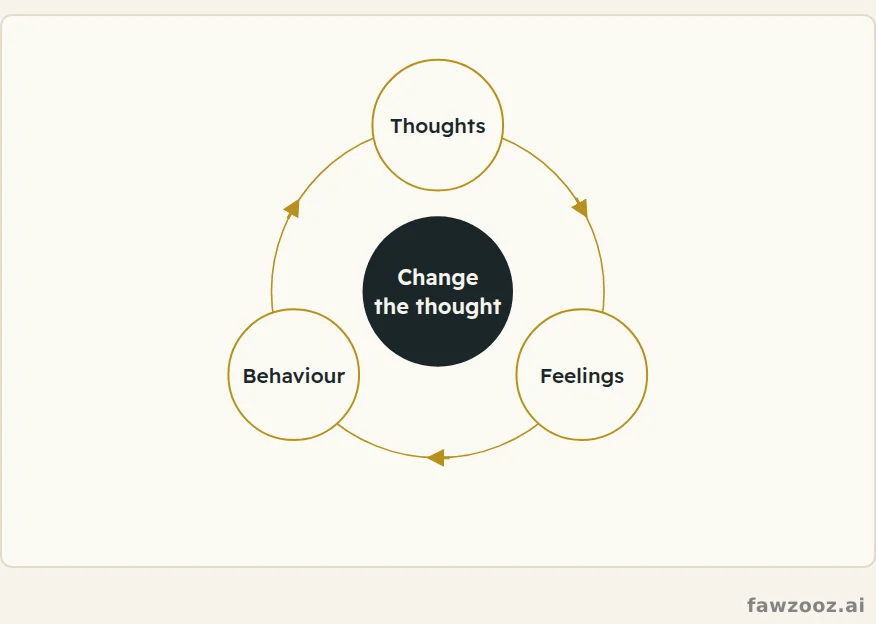
After intensive reading I discovered cognitive behaviour therapy (CBT), which gave me a framework for understanding how my thoughts directly affect my feelings and behaviour, and how negative thoughts, if left unchecked, turn into a spiral that is hard to escape.
Text in this figure
Change · the thought · Thoughts · Feelings · Behaviour · Figure 4
One night I sat with a pen and paper and wrote down every negative thought in my head: “I am not good enough,” “I will certainly fail,” “People don’t take me seriously.” Looking at the page, I realised these thoughts had always been with me, but this time I decided to confront them.
Challenge One: Cognitive Restructuring
One of the key methods of CBT is cognitive restructuring: challenging negative thoughts and replacing them with more realistic and positive ones. I took each thought I had written and analysed it as if in a trial, with my mind reviewing the evidence and weighing its truth.
I began with the first: “I am not good enough.”
Is that true? Is there real evidence for it? I remembered my past achievements and the times I had overcome hard challenges, and asked myself, “If I weren’t good, how did I achieve all this?” I realised the thought was built on momentary feelings, not facts.
Then the second: “I will certainly fail.” I feared failure in every project I started, but I realised failure is not the end of the world and that I had learned from every failure I had been through, so I wrote beside it: “Failure is part of learning.”
In this way I turned every negative thought into a chance to challenge myself and improve how I think. It was not easy; the thoughts tried to return again and again, but I was ready for them every time.
Exercise: Put the Thought on Trial
Write down a recurring negative thought, then draw two columns beneath it: “Evidence for” and “Evidence against”. Then write a balanced alternative thought based on the evidence rather than the feeling, and repeat it whenever the first thought returns.
Challenge Two: Gradual Exposure
I learned another technique called gradual exposure: facing my fears step by step until I master them instead of running away. I had a constant fear of presenting in front of colleagues; I was tense before every meeting and afraid of criticism or of making a mistake in front of everyone.
So I started by speaking in front of a small group I felt comfortable with. The tension remained, but I noticed it was not as bad as I had imagined and the feedback was positive.
My fear had been built on unrealistic expectations. After several successful attempts I challenged myself in front of a larger audience, and whenever fear came I remembered the rule: one small step forward, face the fear, and acknowledge the feeling without fleeing from it.
Challenge Three: Facing Self-Doubt
The greatest challenge was self-doubt, the inner voice questioning every step, the hidden enemy pushing me back whenever I was about to move forward. I learned that self-doubt is not absolute truth but a voice trying to protect me from failure.
So I decided to treat it as part of me, but not necessarily right.
Whenever it appeared I paused and asked, “Is this true? Or am I just afraid of leaving my comfort zone?” Over time I felt a new strength, and began to see doubt as an invitation to grow rather than to retreat.
Improvement was neither easy nor fast, but I felt I was moving in the right direction. Every negative thought I challenged and every fear I faced brought me another step closer to the balance I had long been seeking.
In Today’s World
Endless scrolling through the polished lives of others on screens feeds the thought “I am not good enough.” Try monitoring what you consume as you monitor your thoughts; constant comparison opens the door to envy and discontent. The Prophet ﷺ said: “Look at those below you, and do not look at those above you, for that is more fitting so that you do not belittle the blessings of Allah upon you.”
Tip: use ← → to move between sections.