

Chapter 5
05Remembrance and Glorification
Having learned to trust Allah and realised the power of relying on Him, I felt a greater need for a constant connection with Him, not only in times of hardship but in every moment of my day. I wanted my heart always connected to Allah, and I found that in dhikr, remembrance and glorification.
I had heard of its virtue, but had not grasped its deep effect when done with sincerity and certainty.
One night, after a long day of work and challenges, I sat in a quiet corner of my room and began to glorify Allah: SubhanAllah, Alhamdulillah, Allahu Akbar. With every repetition my heart grew calmer.
At first the words came out mechanically, but soon I felt that glorification is not words to be said but a way to renew my connection with Allah at every moment; words whose meanings touch the soul and make me reflect on Allah’s greatness and vast mercy, reminding me that Allah is greater and more merciful than anything I face.
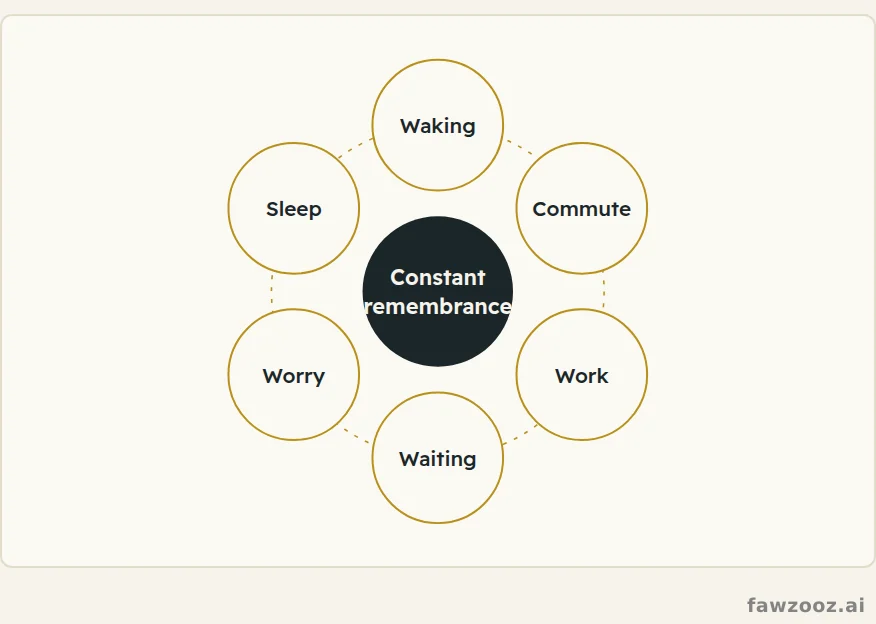
Text in this figure
Constant · remembrance · Waking · Commute · Work · Waiting · Worry · Sleep · Figure 13
So I wove dhikr into my daily routine: I began my morning with Alhamdulillah for the blessings around me, repeated SubhanAllah on the way to work while reflecting on the beauty of creation, and said Allahu Akbar in moments of worry, feeling that Allah is greater than all my concerns.
Over time dhikr was no longer a separate religious practice but an essential part of my day, bringing deep tranquillity, helping me stay calm amid pressure, and reminding me that Allah is present and that I can turn to Him at any time and place.
One day, sitting in the garden reflecting, a light wind passed through the trees as the sun set slowly, and I began to glorify Allah, feeling the moment was a gift and a chance for deep connection. With every SubhanAllah my heart grew purer and more at ease.
I realised dhikr is not worship alone but a path to psychological and spiritual balance; it returns me to my centre, reminds me Allah is with me whatever the circumstances, and reorders my priorities.
Dhikr connected me not only to Allah but improved my relationships with people. It gave me a strength that calmed me and made me more patient and understanding; when I grew angry or tense at work I paused and remembered Allah, and the anger melted and patience took its place.
One night, sitting with my family at the end of a long day, I realised dhikr had brought me closer to them too; the calm of my soul was reflected in my relationship with my wife and children, and I felt Allah blessing my time and relationships.
Dhikr is not only a way to ask forgiveness or to supplicate, but a state of lasting connection with Allah that gives strength to face whatever life brings.
Exercise: Anchors of Remembrance
Attach a short dhikr to events that recur in your day: waking, getting into the car, waiting for a meeting, unlocking your phone. Within a week these anchors will be bringing you back to Allah automatically dozens of times a day.
In Today’s World
The phone has become the first thing we reach for while waiting. Make waiting itself a time for dhikr instead of scrolling; a minute in a queue or a lift is enough for words of glorification that weigh heavy on the scale.
Tip: use ← → to move between sections.