

Chapter 14
14When Do We Need Human Compassion?
“AI excels at optimization, but it is the human heart that brings empathy, compassion and nuanced judgment.”
AI applications range from efficient processes needing almost no oversight to complex decisions where empathy and creativity are indispensable. Knowing what to automate and what to augment with human empathy is a precondition for truly successful solutions. In this chapter we classify tasks and define the right “human + AI” balance.
Defining the Spectrum: Empathy vs. Optimization
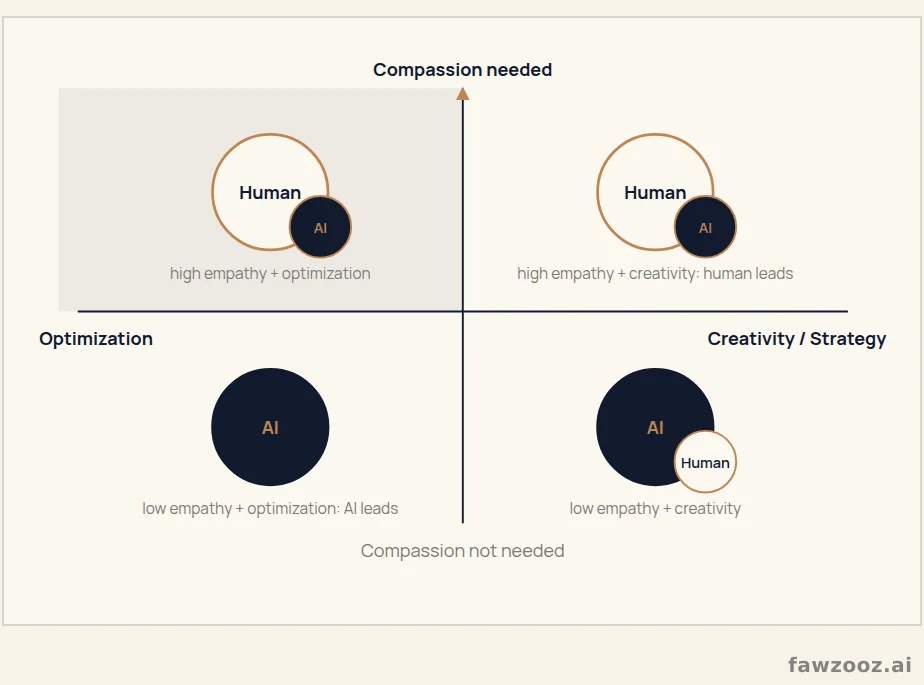
A useful way to classify tasks is along two dimensions:
- High empathy: interactions requiring emotional intelligence or sensitive judgment: counseling, healthcare and nuanced customer service.
- Low empathy: processes where emotion is irrelevant: warehouse stock checks and data analysis.
- High creativity / strategy: out-of-the-box thinking, complex problem-solving and decisions under uncertainty.
- Low creativity (pure optimization): well-defined tasks with clear parameters and outcomes: repetitive clustering and simple classification.
Text in this figure
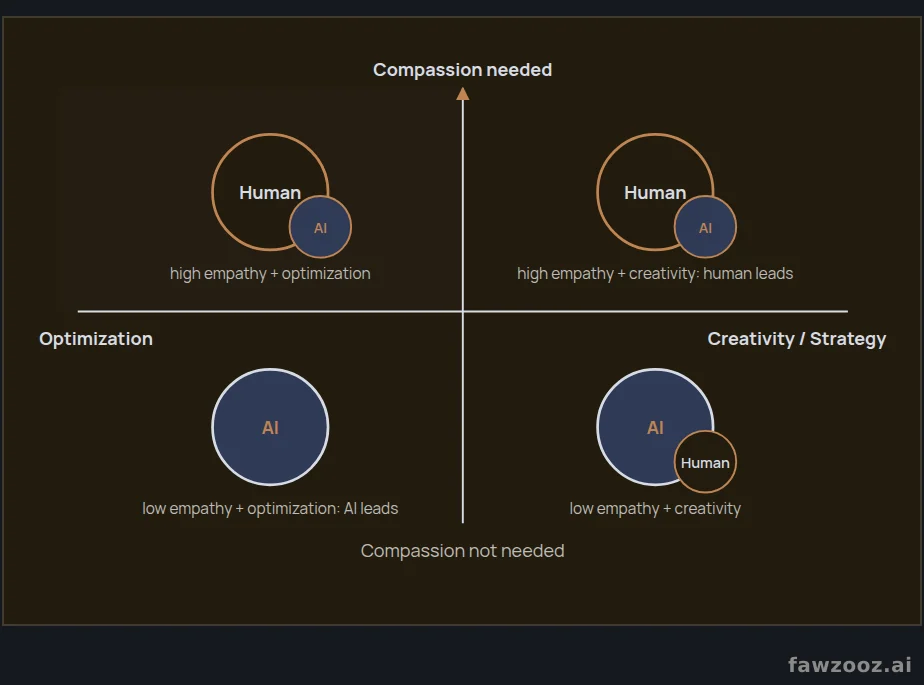
Compassion needed · Compassion not needed · Optimization · Creativity / Strategy · Human · AI · Human · AI · AI · AI · Human · high empathy + optimization · high empathy + creativity: human leads · low empathy + optimization: AI leads · low empathy + creativity · Figure 18 · * This figure was developed from concepts presented in the Post Graduate Program in AI for Leaders (UT Austin McCombs / Great Learning).
The Quadrants: Where AI Shines and Where Humans Excel
High empathy + high creativity: human-led
- Therapy and counseling: AI can transcribe sessions and analyze speech patterns, but empathy and trust come from the therapist.
- Executive leadership: decisions on culture, employee well-being and strategic pivots require emotional intelligence and vision.
High empathy + optimization: human + AI
- Customer-support escalation: chatbots for routine questions, people for emotionally charged issues.
- Healthcare triage: AI assists the initial assessment, while communication and emotional support stay with nurses and doctors.
Low empathy + high creativity: AI + human
- Product design: AI generates prototypes and new combinations; the designer picks what fits the brand and the user.
- Business strategy: AI forecasts market trends; leaders shape moves by blending data with intuition and experience.
Low empathy + low creativity: AI-led
- Order processing and fulfillment: labelling parcels and sorting shipments.
- Data entry: automated workflows extract, validate and categorize data with minimal human oversight.
When to Combine Human and AI Effort
Recognizing where AI struggles
Models stumble on emotional nuance, complex moral judgments, and data that is scarce or unrepresentative. Identifying these limits early keeps humans in the loop.
Designing the handoff
Many processes benefit from a “human-in-the-loop” design: AI handles 80–90% of routine work, and people step in for the final 10–20%, raising efficiency while preserving empathy and sensitivity to context.
- Set clear rules for when the machine refers a task to human review.
- Tell users when the interaction moves from machine to person: “transferring you to a specialist now...”
Balancing cost and value
Involving people raises labor cost, but may improve outcomes in critical decisions and high-touch interactions. Run a cost-benefit analysis: do user satisfaction or fewer errors justify the extra resources?
Real-World Examples
| Domain | AI’s role | Human role | Value |
|---|---|---|---|
| Telehealth | analyzes intake forms, flags emergencies, suggests diagnoses | emotional support, interpreting nuances of history, the treatment decision | doctors for complex cases, AI for repetitive triage |
| Marketing campaigns | predicts behavior, segments audiences, automates A/B tests | the emotional message, creative direction, key-client relationships | more time for creative strategy |
| Education and tutoring | personalizes lessons, spots weaknesses in real time, tracks progress | encouragement, motivation, reassurance, social context | targeted support for students, teachers freed from routine |
Ethical Implications: Keeping Humans in Control
- Accountability: who is responsible if an automated recommendation causes harm or distress?
- Bias and fairness: AI may discriminate unintentionally if trained on biased data, and human oversight ensures fairness.
- Trust and transparency: users should know when they deal with a machine and when with a person, as several laws now require, including the EU AI Act.
Considerations for Choosing an Approach: Machine or Human?
- Task complexity: does it involve variables or shifting conditions a static model may not handle?
- Data availability: is there enough clean, relevant data for effective learning?
- Emotional sensitivity: does success depend on empathy, persuasion or cultural nuance?
- Risk tolerance: could errors harm individuals or reputation? If so, human judgment may need to override the machine.
- Strategic value: does the human perspective add a unique edge or insight?
Lessons Learned
- 1Assess tasks by their need for empathy and creativity versus pure optimization.
- 2Most real scenarios benefit from “human + AI,” especially high-stakes ones.
- 3Automating sensitive tasks requires caution and clear accountability.
- 4No one approach fits all; every organization finds its own balance.
- 5The goal is better outcomes while preserving human dignity and creativity.
Tip: use ← → to move between sections.