

Chapter 9
09Teaching the Machine “How to Think”: From Speed to Depth
“The key to success is not the speed of the answer, but the organized thinking that precedes it.”
You may write a perfect prompt with all four ingredients, and still the model “jumps” to a wrong conclusion: you pose a riddle that needs several steps of reasoning, and it answers confidently, quickly.. and completely wrongly. Why?
Why Do Models Jump to Wrong Conclusions?
Foundation models are, at heart, statistical prediction engines trained to predict “the most probable next word.” Faced with a riddle like “I have water but I am not a sea, I have banks but I am not a shore. What am I?” they may fail for two reasons:
- Quick association: they see “water” and statistically link it to “bottle” or “tank” because the association is common in training data.
- Ignoring constraints: in the leap, they skip the decisive clue: “I have banks.”
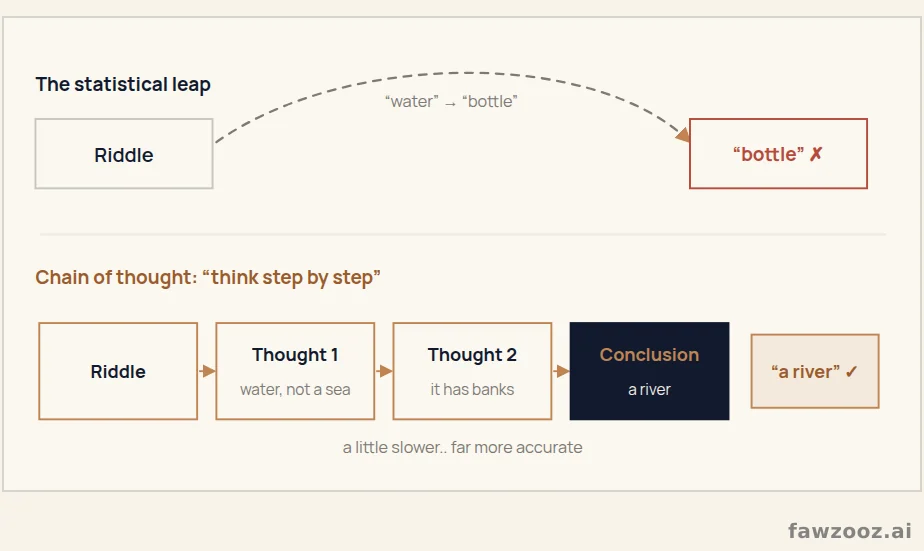
Text in this figure
The statistical leap · Riddle · “water” → “bottle” · “bottle” ✗ · Chain of thought: “think step by step” · Riddle · Thought 1 · water, not a sea · Thought 2 · it has banks · Conclusion · a river · “a river” ✓ · a little slower.. far more accurate · Figure 13
The “Chain of Thought” Technique
The fix is a technique called Chain-of-Thought: instead of asking only for the final answer, we ask the model to “think step by step.” This simple phrase slows the statistical leap and engages reasoning before the conclusion.
- The ordinary prompt: “I have water but I am not a sea, I have banks but I am not a shore. What am I?” → likely answer: “a bottle” (wrong).
- The chain-of-thought prompt: the same riddle plus: “think step by step before answering.”
- First thought: something that holds water but is not as vast as the sea: a pond, a river, a glass.
- Second thought: “banks” are edges; a glass has none, a pond may, a river certainly does.
- Conclusion: what holds water and has banks, excluding sea and shore, is “a river” (correct).
Reasoning Models: When Step-by-Step Became Built In
2026 Update
What began as a prompting trick is now a built-in capability: “reasoning models” are trained with reinforcement learning to think internally before answering, spending more time and compute “at answer time” (test-time compute) to solve hard math, coding and analytical problems. This changes the rules: with these models it is often enough to explain the goal and the criteria clearly without dictating steps, and to choose the right level of “effort”; longer thinking is more accurate, but slower and costlier. Wisdom lies in using fast models for simple tasks and reflective ones for complex tasks.
- Complementary techniques: self-verification: “review your answer and list its weaknesses.” Decomposition: “break the problem into sub-questions.” And generating several alternatives, then choosing the best.
From “User” to “Teacher”
Chain of thought reveals a deep shift in our relationship with the machine: we do not just use it as a super-fast calculator; we “teach it how to think” by guiding its reasoning, in riddles, mathematics and strategic analysis alike.
Lessons Learned
- 1Models can err because they favor quick statistical association over logical reasoning.
- 2“Chain of thought” forces the model to slow down and reason methodically.
- 3For complex problems add “think step by step,” or choose a reasoning model.
- 4Longer thinking is more accurate but costlier; match effort to the task.
- 5Our role has evolved from “user” to “teacher” guiding the machine’s thinking.
Tip: use ← → to move between sections.