

Chapter 7
07The Wonders of AI at Work
“We are not just building better machines; we are amplifying human potential.”
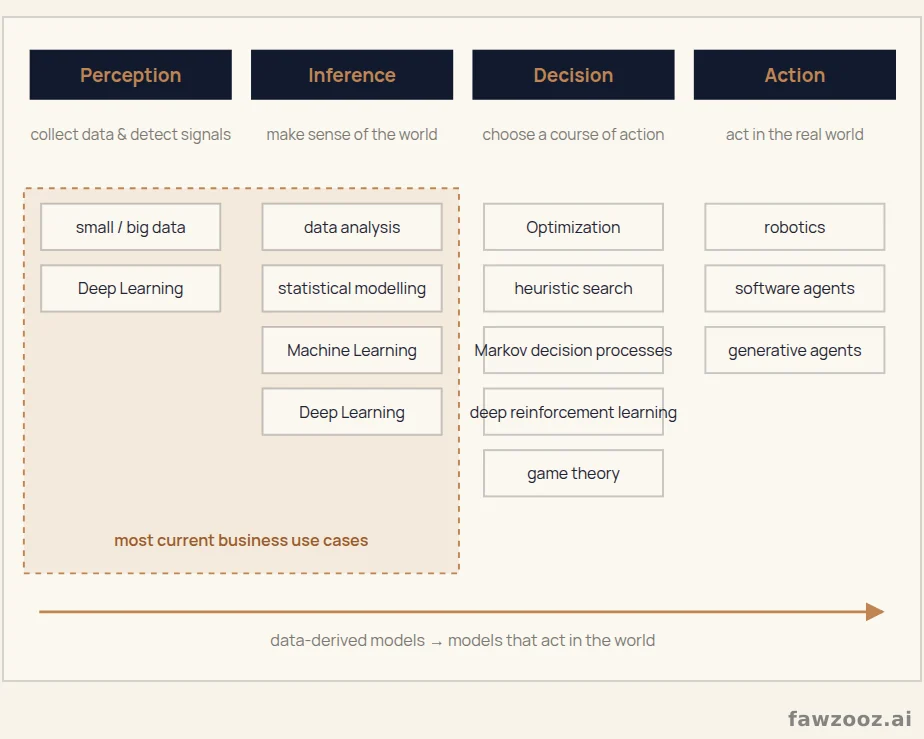
The true wonder of AI appears when we see it at work: spotting anomalies in X-rays, predicting consumer behavior, driving vehicles and producing animation that once required painstaking manual work. These tasks fall into four categories that mirror the thinking cycle: perception, inference, decision and action, and creative output.
Text in this figure
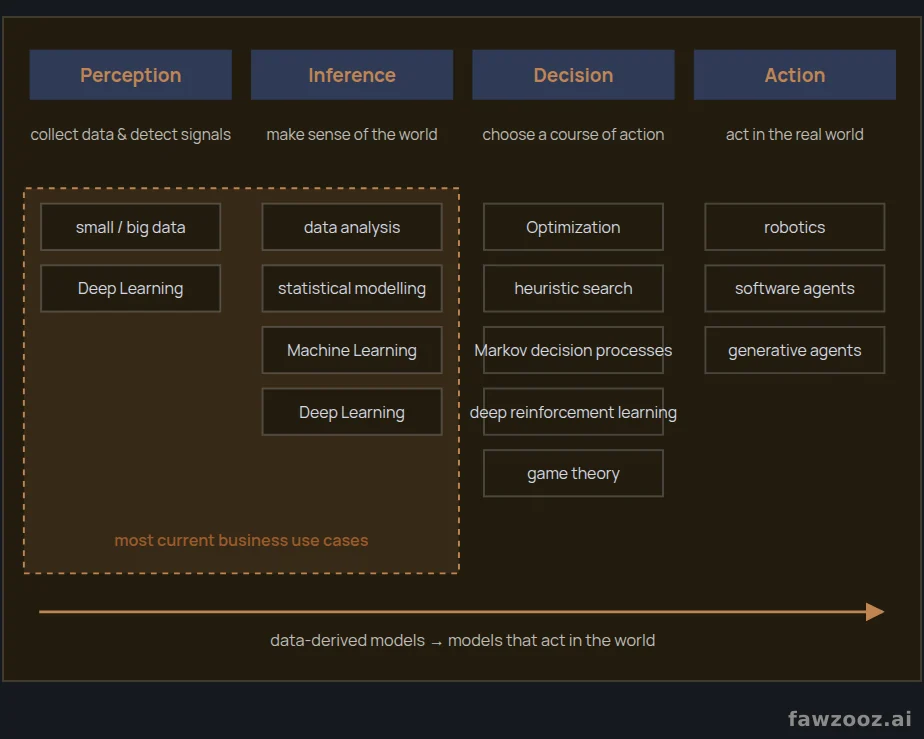
most current business use cases · Perception · collect data & detect signals · small / big data · Deep Learning · Inference · make sense of the world · data analysis · statistical modelling · Machine Learning · Deep Learning · Decision · choose a course of action · Optimization · heuristic search · Markov decision processes · deep reinforcement learning · game theory · Action · act in the real world · robotics · software agents · generative agents · data-derived models → models that act in the world · Figure 11 · * This figure was developed from concepts presented in the Post Graduate Program in AI for Leaders (UT Austin McCombs / Great Learning).
Perception: How AI Sees, Reads and Hears
Perception is interpreting the world from sensory data: images, text and sound. It is like giving machines “eyes,” “ears” and the ability to “read.”
Vision
- Medical imaging: detecting tumors and anomalies in X-rays, MRI and CT scans, sometimes matching radiologists in accuracy.
- 3D vision: interpreting spatial data for navigation in drones and autonomous vehicles.
- Edge processing: smart cameras process footage locally rather than sending it to the cloud, crucial on factory floors where low latency is required.
Why it matters: machine vision democratizes expert analysis: doctors catch problems earlier and manufacturers automate defect detection, reducing errors and cost.
Text (large language models)
- Document analysis: summarizing legal documents, flagging critical clauses and drafting first versions of contracts.
- Sentiment analysis: reading social posts and product reviews to gauge public opinion in real time and guide marketing.
- Summarization: condensing a hundred-page report into an executive summary that speeds up decisions.
Speech
- Speech recognition: voice assistants turn spoken commands into actionable requests.
- Real-time transcription: live captioning of meetings and lectures, serving deaf and hard-of-hearing people.
- Instant translation: breaking language barriers and easing global collaboration, up to live translated voice conversation.
As speech interfaces improve, people spend less time learning the machine’s language and interact with devices as naturally as with each other.
Inference: Extracting Insight from Data
Inference is predicting or classifying based on known data.
- Banking and finance: churn prediction for proactive retention, real-time fraud detection, and faster, more consistent assessment of creditworthiness and claims.
- Retail and e-commerce: demand forecasting from sales history, seasonality and social trends to prevent stock-outs and overstock, and personalized recommendations that lift satisfaction and revenue.
- Industry and manufacturing: predictive maintenance from temperature and vibration sensors before failure, and quality control that finds microscopic scratches on semiconductor wafers.
Good inference reduces guesswork: organizations anticipate needs and risks before they become critical.
Decision and Action: From Autonomous Vehicles to Automated Trading
- Autonomous vehicles: self-driving trucks for long hauls improve supply-chain efficiency and safety, vehicles in mining and agriculture protect operators and cut costs, and robotaxis now operate commercially in several cities.
- Automated trading: deep reinforcement learning agents buy and sell in fractions of a second, and algorithms balance risk and return in portfolio management.
- Robotics: humanoid robots for assembly and services, and coordinated drone swarms for disaster relief and crop monitoring, making split-second decisions.
When AI moves beyond recommendation to action, it unlocks gains in efficiency and safety that manual processes cannot reach.
Creative Tasks: Inspiration, Not Just a Tool
- Animation: tools that reduce frame-by-frame drawing and map motion-capture data onto 3D characters, freeing artists for style and story.
- Content writing: generative assistants draft articles, brainstorm ideas and refine outlines, and produce multiple ad variants for rapid testing.
- Design: suggesting layouts and color palettes, producing concept art and quick prototypes, up to generating video from a text description.
Machine-driven creativity is a starting point, not a substitute for originality: people keep the emotional core and the final aesthetic judgment.
Understanding the Breadth of AI
These wonders share one thread: AI thrives when abundant, well-organized data meets powerful algorithms, and it is only as strong as the data foundation and the context human expertise provides.
- Data quality: “the quality of inputs determines the quality of outputs.”
- Interdisciplinary collaboration: data scientists, domain experts, software engineers and business strategists together.
Before you continue, reflect: where do you see the greatest “wonders of AI” in your own context? Automating a tedious process? Or real-time insights you never thought possible?
Lessons Learned
- 1Perception: machines see, read and hear, from medical diagnosis to global collaboration.
- 2Inference: predictive models anticipate needs, detect fraud and forecast demand.
- 3Decision and action: vehicles, trading and robots make decisions with minimal human intervention.
- 4Creative output: drafts and early concepts free the creator for higher-level work.
- 5Collaboration is key: people direct, refine and instill ethics.
Tip: use ← → to move between sections.