

Chapter 17
17Building the AI Team
“AI is a team sport; no single person masters data engineering, modelling, strategy and deployment at once.”
A lone “AI expert” cannot manage data pipelines, build models and align them with strategy. The organization needs a cross-functional team, each member bringing specialized skills.
Why Cross-Functional Teams?
- Diverse perspectives: data scientists excel at modelling but need domain experts to interpret, and software engineers ensure robust deployment.
- Shared accountability: no single role “owns” AI; distributing responsibility prevents bottlenecks and spreads risk.
- Faster iteration: an expert for each stage of the lifecycle shortens time to market.
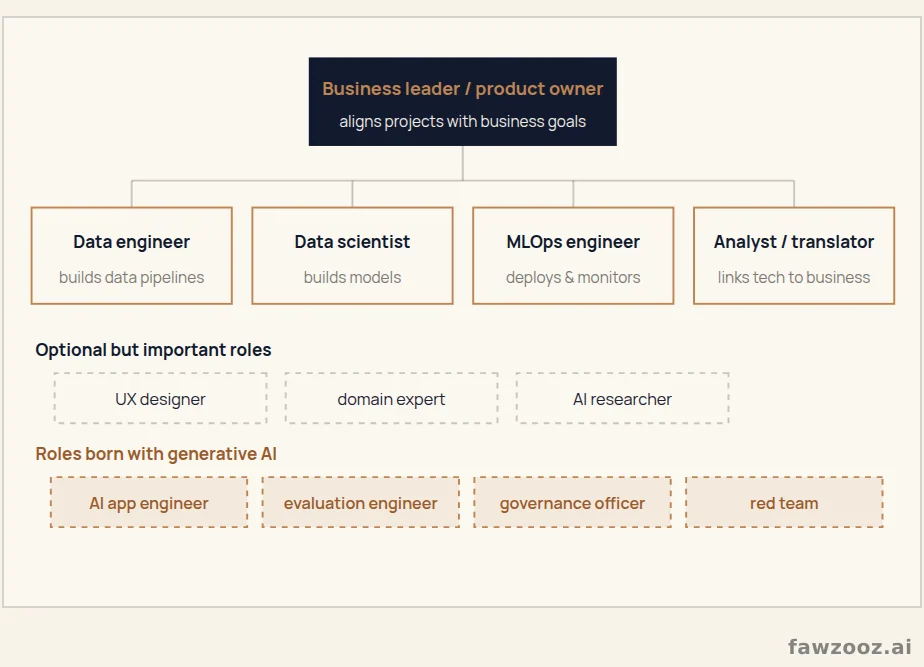
Text in this figure
Business leader / product owner · aligns projects with business goals · Data engineer · builds data pipelines · Data scientist · builds models · MLOps engineer · deploys & monitors · Analyst / translator · links tech to business · Optional but important roles · Roles born with generative AI · UX designer · domain expert · AI researcher · AI app engineer · evaluation engineer · governance officer · red team · Figure 23
Core Roles: The Minimum Viable Team
- Business leader / product owner: aligns projects with strategy: defines high-impact use cases and success metrics, and communicates value to stakeholders. Background: domain expertise and enough AI literacy to talk with technical teams.
- Data engineer: ensures reliable data pipelines: ingestion, transformation and storage (ETL/ELT), warehouses, lakes and real-time streams, security and compliance. Background: SQL/NoSQL, cloud (AWS, Azure, GCP) and tools such as Airflow and Spark.
- Data scientist / ML engineer: builds models and experiments: exploration, statistical analysis and feature engineering, training, tuning and evaluation. Background: math and statistics, Python and R, frameworks such as PyTorch and Scikit-learn.
- MLOps / DevOps engineer: bridges development and production: Docker and Kubernetes containers and version management, CI/CD automation, and monitoring of performance and drift. Background: software engineering, cloud orchestration and model serving.
- Analyst / data translator: the link between technical and non-technical people: clarifies requirements, interprets results for executives and relays user feedback. Background: strong communication, basic statistics and data storytelling.
Optional but Important Roles
- UX/UI designer: makes applications intuitive and accessible, such as real-time analytics dashboards.
- Subject-matter experts: deep knowledge of medicine, finance or retail; advise on regulatory constraints, identify features and validate outputs.
- AI researcher: pushes the boundaries of algorithms and adapts cutting-edge research to the organization’s cases.
Roles Born with Generative AI
2026 Update
The foundation-model era added new roles to the team: the “AI application engineer” who builds on ready models with prompts, retrieval and agents; the “evaluation engineer” who designs tests and measures answer quality and safety; the “AI governance officer” who manages risk and compliance; and the “red-teamer” who attacks the system before others do. In small teams one person may combine several roles.
Collaboration Across the Lifecycle
| Stage | Who does what? |
|---|---|
| Acquisition and preparation | the data engineer makes data available and organized, the scientist proposes feature engineering, and the analyst and expert identify the most relevant variables |
| Modelling and evaluation | the scientist designs experiments, MLOps automates training and testing, and the leader and analyst tie metrics to ROI and satisfaction |
| Deployment and operations | MLOps manages environments, containers and monitoring, the scientist stands by to retrain, and the analyst gathers user feedback |
| Continuous improvement | the leader reassesses fit and proposes new cases, the engineer provides new sources, and everyone collaborates as the market shifts |
Building or Upskilling Your Team
- Interdisciplinary hiring: people who thrive in shared environments, not in a single silo.
- Cultural fit: a culture of experimentation comfortable with iteration and ambiguity.
- External experts: especially at the start, for “novice” organizations.
- Internal upskilling: workshops in Python, SQL and Spark, mentoring that pairs juniors with experts, and courses and certifications via Coursera, edX and cloud providers.
Common Pitfalls and How to Avoid Them
- Relying on a single “rockstar”: risk: burnout, bottlenecks and knowledge silos. Solution: knowledge sharing, teamwork and documentation.
- Mismatched roles and expectations: risk: scientists fixing pipelines instead of modelling, and impossible deadlines. Solution: clear responsibilities and open channels.
- No executive sponsorship: risk: projects stall without budget. Solution: secure support early by highlighting return.
- Ignoring soft skills: risk: excellent technical solutions fail in communication. Solution: develop presentation and negotiation skills.
Lessons Learned
- 1Success depends on an alliance of roles: business, data, engineering, operations and analysis.
- 2The minimum: a business leader, a data engineer, a data scientist, an MLOps engineer and an analyst.
- 3Soft skills are integral to success.
- 4Continuous learning and a culture of experimentation keep the team current.
- 5The team grows with maturity, adding roles for generation, evaluation and governance.
Tip: use ← → to move between sections.