

Chapter 15
15The AI Maturity Journey
“Adopting AI is not a one-time decision, but a continuous evolution of strategy, culture and capability.”
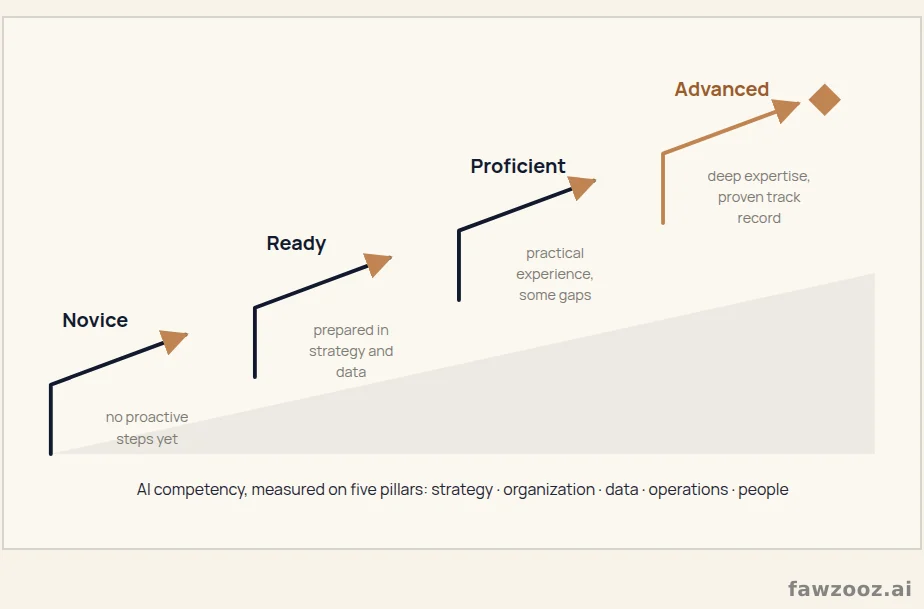
Many organizations dream of AI for efficiency, innovation and competitiveness, but few realize that success requires more than a flashy proof of concept. It is a coordinated progression we call the “maturity journey,” from early experimentation to AI integrated across the enterprise.
Text in this figure
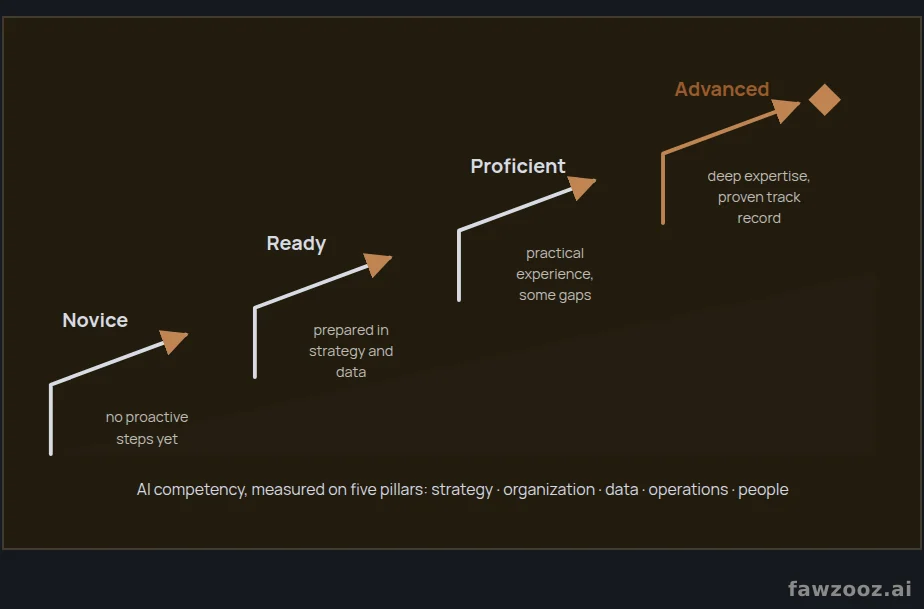
Novice · no proactive · steps yet · Ready · prepared in · strategy and · data · Proficient · practical · experience, · some gaps · Advanced · deep expertise, · proven track · record · AI competency, measured on five pillars: strategy · organization · data · operations · people · Figure 19 · * This figure was developed from concepts presented in the Post Graduate Program in AI for Leaders (UT Austin McCombs / Great Learning).
The Four Stages of AI Maturity
Novice
- Characteristics: few or no formal projects, skeptical or hesitant leadership, disorganized data and infrastructure with no strategy.
- Mindset: “should we invest in AI?”, “we don’t have the data or the people.”
- Immediate steps: educate decision-makers on use cases, benefits and limits; audit data and its quality; run low-risk experiments and proofs of concept (POCs).
Ready
- Characteristics: curiosity has become plans, management allocates resources, data pipelines and cloud platforms are in their early days.
- Mindset: “we see the potential, so how do we execute effectively?”, “we need a strategy that ties projects to business goals.”
- Immediate steps: align strategically with high-impact problems such as churn and supply chains; build a core team of a data scientist, a data engineer and a project manager; standardize data collection, storage and cleaning.
Proficient
- Characteristics: successful pilots and expanding use cases, knowledge spreading across business units, a maturing data strategy with gaps in scaling and collaboration.
- Mindset: “AI works; how do we make it part of our standard toolkit?”, “we need to streamline workflows and governance.”
- Immediate steps: embed outputs in daily decisions, automate deployment, monitoring and updates through MLOps, and train teams continuously.
Advanced
- Characteristics: AI is woven into operations and culture, multiple models work together with measurable return, and infrastructure and governance support continuous innovation.
- Mindset: “AI is the core of our competitive edge,” “we must stay at the forefront of research.”
- Immediate steps: expand into new domains and advanced techniques, partner with universities, research labs and open source, and strengthen ethics and compliance.
The Five Assessment Pillars
| Pillar | Definition | Key question |
|---|---|---|
| Strategy | a clear vision of how AI creates value | are initiatives aligned with goals and performance metrics? |
| Organization | cultural readiness, leadership support and roles | does leadership champion it? Are there cross-functional teams? |
| Data | availability, quality, management and governance | are sources well-defined, accurate and scalable? |
| Operations | daily structures for deployment and maintenance (MLOps, DevOps) | do we have robust systems to deploy, monitor and update? |
| People and skills | talent to design, execute and scale initiatives | do we have the right mix of scientists, engineers, analysts and business experts? |
Typical Challenges Between Stages
- Novice to Ready: challenge: senior-management skepticism. Solution: quick wins with tangible return.
- Ready to Proficient: challenge: siloed projects without a unified strategy or data architecture. Solution: an enterprise roadmap, central data governance and deployment best practices.
- Proficient to Advanced: challenge: scaling infrastructure and consistent performance across many models and units. Solution: robust MLOps, agile methods and cross-functional expertise.
Assessing Your Organization
An organization often spans more than one stage: “ready” in one department and “novice” in another. A realistic self-assessment reveals inconsistencies and priorities, and consulting and technology firms offer readiness assessment tools.
- Frequency of data-driven decisions.
- Share of processes automated or augmented by AI.
- Leadership vision and budget allocation.
- Employee skill levels in data science, machine learning and AI engineering.
- Share of employees using generative assistants safely under an approved policy.
Practical Tips to Advance Maturity
- A coherent vision: consensus on AI’s place in long-term strategy, and use cases that inspire departments.
- Start small, scale fast: pilots in a controlled environment, then rapid iteration and wider rollout once value is proven.
- Invest in people: workshops, courses and mentoring, and contracting specialized talent when needed.
- Strong governance: policies for privacy, quality and compliance (GDPR, CCPA), ethical standards and accountability frameworks, and an approved AI management framework such as ISO/IEC 42001.
- Institutional collaboration: partnerships with universities, labs and startups, and industry consortia to share experience.
- Continuous improvement: agile methods, feedback loops, performance tracking and retraining.
2026 Update
Generative AI added a parallel maturity track: many organizations moved quickly from “banning” generative assistants to “allowing them under a policy,” then to building internal applications on them, then to agents working in operations. Maturity here is measured not by the number of tools, but by having a usage policy, a classification of data allowed as input, and measurement of impact.
From AI Maturity to Cognitive Security Maturity
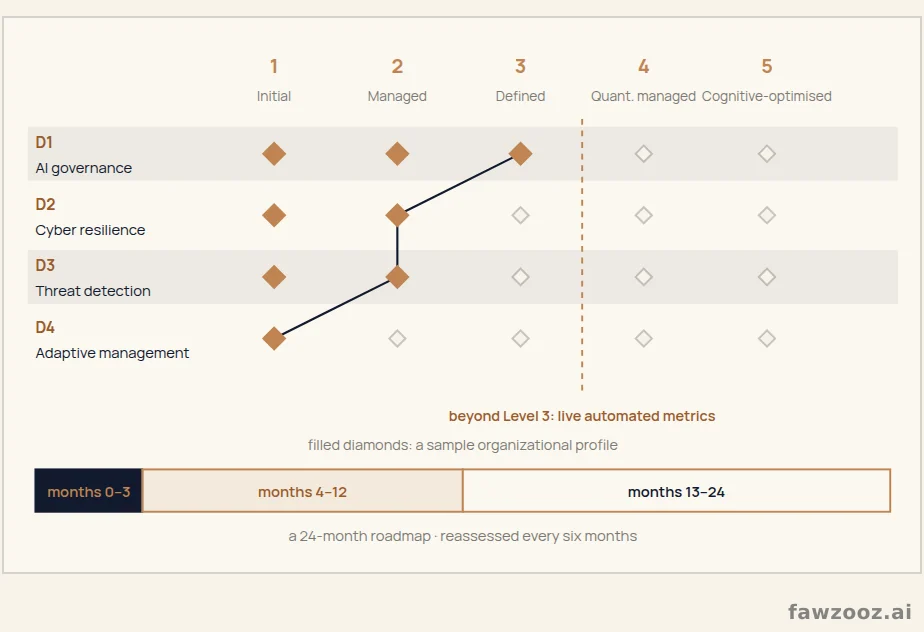
When a machine takes part in a decision, it is not enough to ask whether the organization uses AI well; we must ask whether it protects its decision once a machine shares in it. For that question I built, in my doctoral research, the Unified Cognitive Security Maturity Model (UCSMM), on a field study of 212 organizational leaders. The findings showed that organizations with higher cognitive security maturity are more resilient against AI-driven threats and better able to manage complex digital environments.
Text in this figure
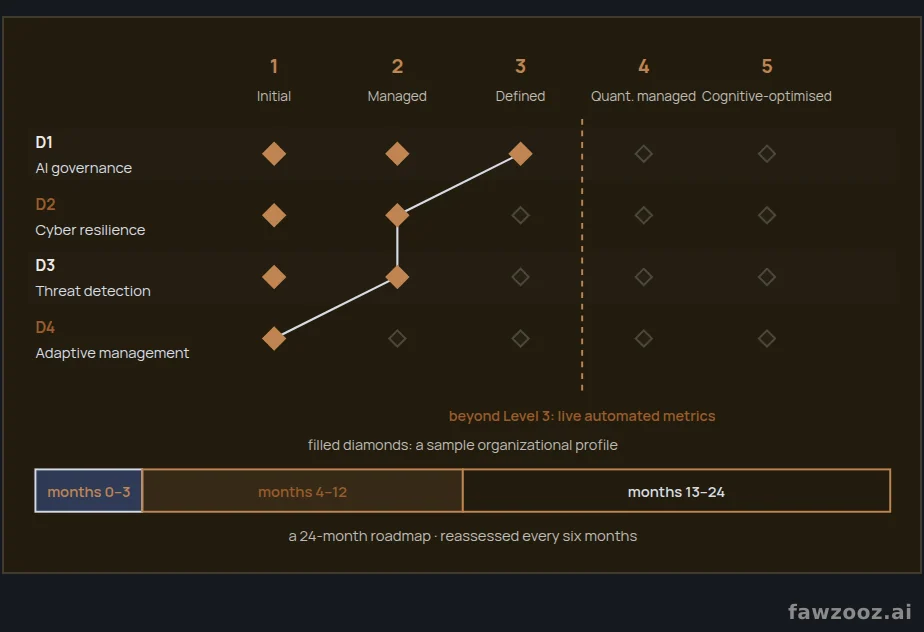
1 · Initial · 2 · Managed · 3 · Defined · 4 · Quant. managed · 5 · Cognitive-optimised · D1 · AI governance · D2 · Cyber resilience · D3 · Threat detection · D4 · Adaptive management · beyond Level 3: live automated metrics · filled diamonds: a sample organizational profile · months 0–3 · months 4–12 · months 13–24 · a 24-month roadmap · reassessed every six months · Figure 20
- Four dimensions: AI governance (D1), cyber resilience (D2), threat detection (D3) and adaptive management (D4).
- Five Levels: Initial, Managed, Defined, Quantitatively managed and Cognitive-optimised.
- Twenty assessment items: five items per dimension, each scored 1 to 5; a dimension’s Level is its average rounded down, so an average of 2.6 means Level 2.
- The rule beyond Level 3: no dimension rises above Level 3 without live dashboards and metrics pulled automatically from systems.
- A 24-month roadmap: months 0 to 3, then 4 to 12, then 13 to 24, with reassessment every six months.
The five pillars measure an organization’s ability to “use” AI; the unified model measures its ability to “protect the decision” when a machine shares it. A truly mature organization needs both.
Reaching “Advanced” is not an end point; with quantum computing, newer networks and specialized accelerators, even advanced organizations will need to evolve.
Lessons Learned
- 1Maturity is a journey from novice to advanced, reflecting growth in strategy, data and readiness.
- 2Five pillars: strategy, organization, data, operations and people.
- 3Each stage has its hurdles: skepticism, then silos, then scale.
- 4Quick wins build momentum; governance and skills sustain it.
- 5Even advanced organizations must adapt to new technologies and ethics.
Tip: use ← → to move between sections.