

Chapter 3
03The Map of Concepts: From Definitions to Components
“AI begins as a science of intelligent machines, then becomes a force that reshapes our world and awakens us to new possibilities.”
What exactly is AI? Where do machine learning, deep learning and generative AI fit in the picture? This chapter clarifies the key terms and shows how they come together to power modern systems.
Text in this figure
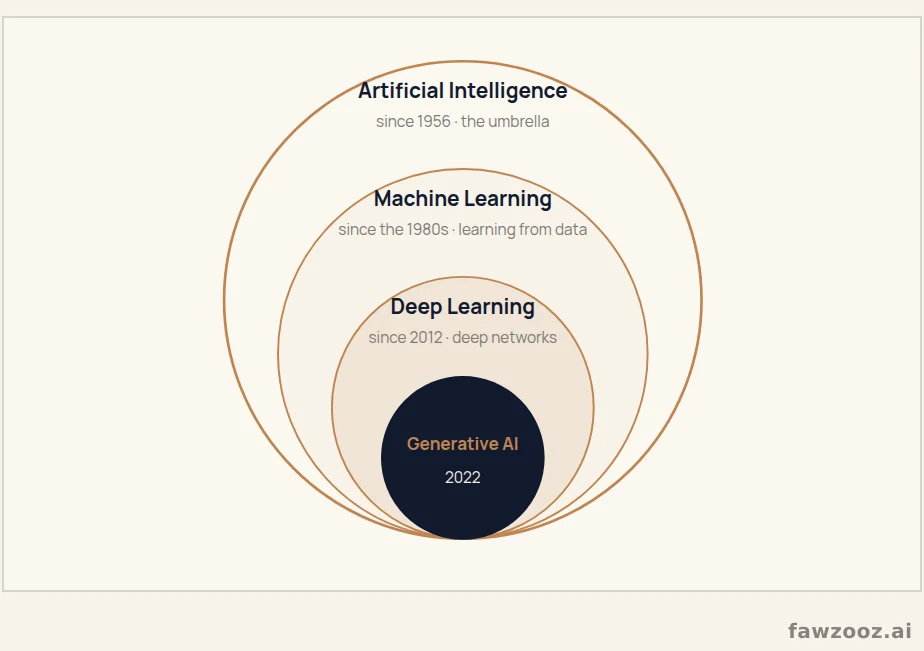
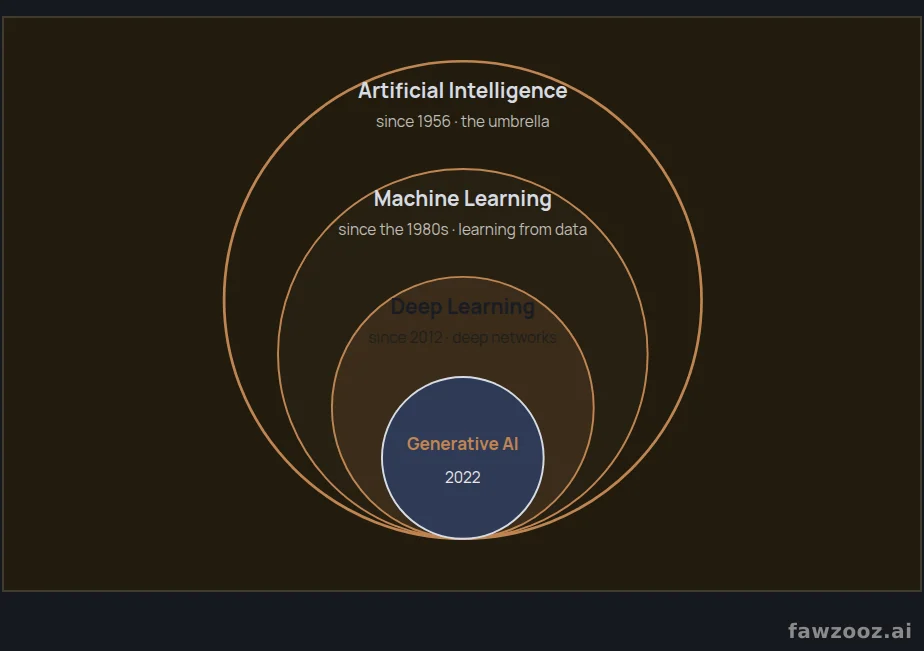
Artificial Intelligence · since 1956 · the umbrella · Machine Learning · since the 1980s · learning from data · Deep Learning · since 2012 · deep networks · Generative AI · 2022 · Figure 4
Defining Artificial Intelligence
Artificial intelligence refers to computer systems or algorithms that mimic, or exceed, human cognitive tasks such as problem-solving, perception, language understanding and decision-making. It is a broad umbrella, from simple “if.. then” logic to neural networks capable of learning on their own.
- Core goal: automate tasks that require some level of intelligence, from filtering spam to driving vehicles.
- Core benefit: process vast amounts of data quickly and consistently, often outperforming humans in speed and accuracy under certain conditions.
Milestones in AI history
- The Dartmouth Workshop (1956): the official birth of the field, led by John McCarthy, Marvin Minsky and others.
- Expert systems (1980s): symbolic AI that captured human expertise as rule-based programs.
- Neural network revival (1990s–2000s): better computing renewed interest in multi-layer networks.
- The deep-learning breakthrough (2012): deep networks and GPUs deliver a leap in computer vision.
- Transformers (2017): the “attention” architecture on which large language models are built.
- The age of generation and agents (2022–today): generative assistants reach the public, followed by reasoning models and agents that use tools.
Understanding Machine Learning
Machine learning is a subset of AI focused on algorithms that “learn” patterns from data. Instead of programming an explicit rule like “if the customer buys X, recommend Y,” the algorithm discovers such rules itself from examples. Chapter 5 details its types: supervised, unsupervised, semi-supervised, reinforcement and self-supervised.
Deep Learning: The Power Behind Modern AI
Deep learning is a subset of machine learning that uses multi-layer, or “deep,” artificial neural networks to learn features and patterns automatically. While traditional ML relies on manual feature engineering, deep learning is designed to learn them end to end.
Key components of neural networks
- Neurons: inspired by biological neurons; each weighs its inputs, sums them and applies an activation function such as ReLU or sigmoid.
- Layers: an input layer, several hidden layers and an output layer; more layers capture more complex patterns.
- Training: backpropagation: predictions are compared with actual labels and weights are adjusted to reduce error.
Why deep learning is so effective
- Automatic feature extraction: learns from raw data such as pixels and sound waves.
- Scalability: with enough data and compute it tackles highly complex tasks like speech recognition, image segmentation and language understanding.
- Transfer learning: pre-trained models carry their “knowledge” to new tasks, greatly reducing the data required.
ML vs. DL: When to Use Each
Text in this figure
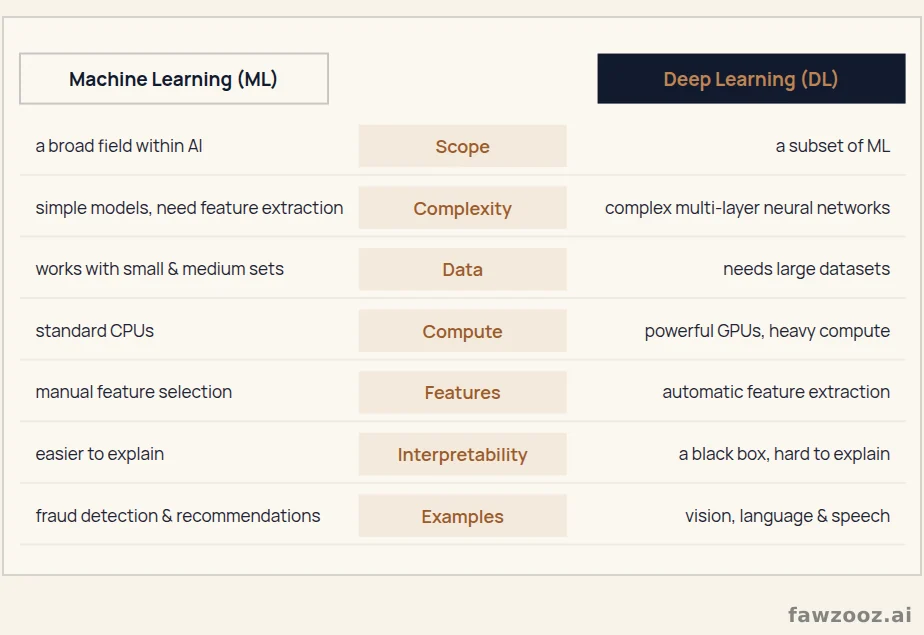
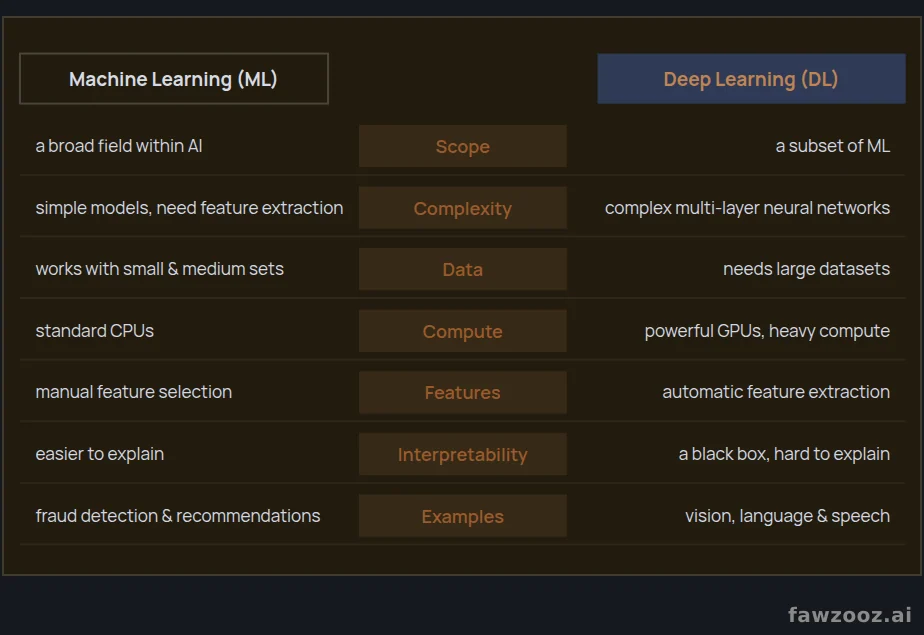
Machine Learning (ML) · Deep Learning (DL) · Scope · a broad field within AI · a subset of ML · Complexity · simple models, need feature extraction · complex multi-layer neural networks · Data · works with small & medium sets · needs large datasets · Compute · standard CPUs · powerful GPUs, heavy compute · Features · manual feature selection · automatic feature extraction · Interpretability · easier to explain · a black box, hard to explain · Examples · fraud detection & recommendations · vision, language & speech · Figure 5
- Pros of traditional (shallow) models: work well with limited data, easier to interpret, faster to train on standard hardware.
- Their cons: require extensive feature engineering and may not scale efficiently with massive datasets.
- Pros of deep learning: excellent on large unstructured data (images, text, audio), automatic feature learning, impressive results in vision and language.
- Its cons: needs huge data and compute, hard to interpret (the black box), prone to overfitting if not managed carefully.
Rule of thumb: start with the simplest model, and move to deep learning when you have the data, the compute and a genuinely complex problem.
Additional AI Paradigms
- Symbolic AI: rule-based systems that encode expert knowledge explicitly; useful for knowledge representation and logical reasoning in well-defined domains.
- Genetic algorithms: evolutionary optimization inspired by natural selection, suited to design, scheduling and any problem where a “fitness function” can be defined.
- Neuro-symbolic AI: combines the interpretability and logical structure of symbolic AI with the pattern-recognition and scalability of neural networks; “the best of both worlds.”
Common Misconceptions
- “AI = robots”: robots are one application; many systems are purely software: recommendation engines, fraud detection, virtual assistants.
- “AI guarantees intelligent behavior”: it may impress in a narrow domain and fail completely outside it; this is “narrow AI.”
- “More data = better AI”: quality matters more; biased or noisy data does not help however much there is, and architecture, hyperparameters and training approach matter greatly.
- “A language model knows the truth”: it is a statistical prediction engine, not a fact database, and can “hallucinate” with confidence; this is why Chapter 12 is devoted to trust.
How AI Fits the Bigger Picture
- Big data: distributed systems such as Hadoop and Spark and modern data warehouses feed the algorithms.
- Cloud computing: elastic, on-demand resources to train and deploy models.
- Edge computing: running models on phones and IoT sensors for real-time processing (Chapter 13).
- APIs and services: cloud providers offer speech-to-text, vision, translation and generative models through ready APIs, lowering the barrier to entry.
Types of AI by Capability
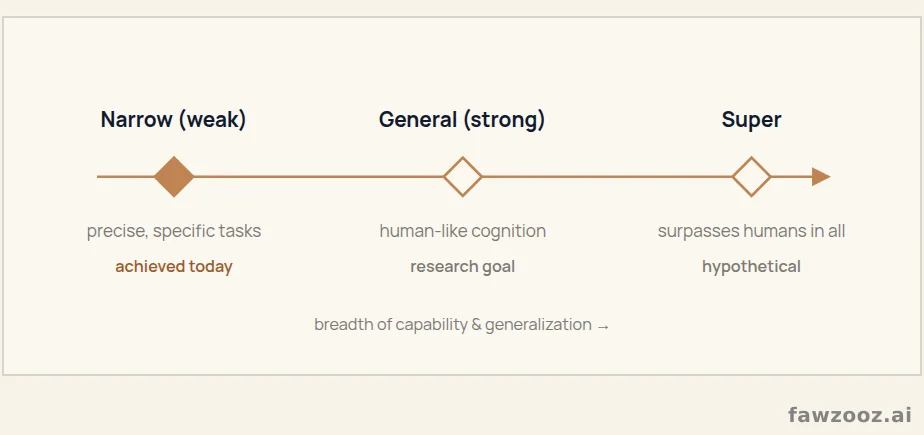
- Narrow (weak) AI: performs specific tasks precisely, such as image recognition and translation; it dominates today but does not generalize beyond its domain. Many researchers still classify even multi-task foundation models here.
- General (strong) AI: systems with human-like cognitive abilities that can learn any intellectual task; still a research goal, with wide debate about its definition and timing.
- Superintelligent AI: surpasses human intelligence in every respect; a hypothetical concept that raises questions about humanity’s future and the governance of technology.
Text in this figure
Narrow (weak) · precise, specific tasks · achieved today · General (strong) · human-like cognition · research goal · Super · surpasses humans in all · hypothetical · breadth of capability & generalization → · Figure 6
With these definitions you are ready for what follows: how the intelligent mind “thinks,” learns and creates, and then how it perceives, infers, decides and creates in the real world.
Lessons Learned
- 1AI is a broad umbrella that includes machine learning, deep learning, symbolic AI and more.
- 2Machine learning learns from data rather than hard-coded rules, and deep learning is its most powerful branch.
- 3Deep learning shines with large, complex data, but is costly and hard to interpret.
- 4Myths abound: not all AI is robots, more data is not always better, and a language model does not necessarily know the truth.
- 5Integration with big data, cloud, edge and APIs is what creates value.
Tip: use ← → to move between sections.