

Chapter 5
05The “Learning” Mind: Paradigms of Acquiring Expertise
“Just as people learn from books, from observation and from experience, machines learn through paradigms designed for the problem at hand.”
Machine learning is the engine that gives AI experience. But how does it actually learn? There is no one-size-fits-all approach. Choosing the right learning paradigm is the first and most important step in any applied project.
Text in this figure
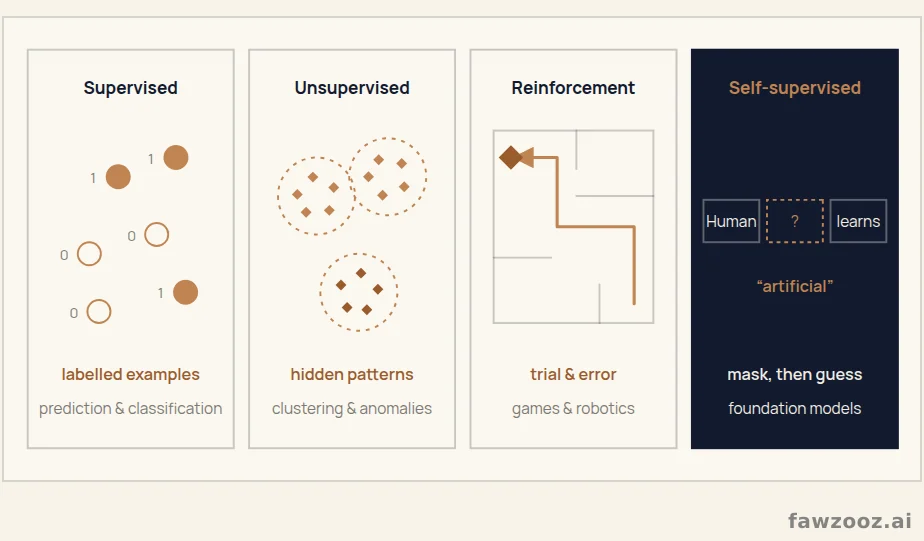
Supervised · labelled examples · prediction & classification · 1 · 1 · 0 · 0 · 1 · 0 · Unsupervised · hidden patterns · clustering & anomalies · Reinforcement · trial & error · games & robotics · Self-supervised · mask, then guess · foundation models · Human · ? · learns · “artificial” · Figure 9
Supervised Learning: Learning from “Labelled Examples”
The most common paradigm in business. It is called “supervised” because we oversee learning by supplying data that already contains the “right answers.”
- The analogy: a robotic detective we want to spot “sick plants.” We give it a catalog of hundreds of photos and say: “this one is healthy” (1) and “this one is sick” (0).
- How it works: it finds subtle patterns, such as yellow spots or curled leaves, that link the input to the label, then classifies new photos it has never seen.
- Applications: classification: is this email fraudulent? Is this transaction legitimate or suspicious? And regression: what is this house worth compared with known houses?
- Common algorithms: linear and logistic regression, decision trees, random forests and XGBoost.
Unsupervised Learning: Discovering “Hidden Patterns”
What if we have no right answers, the data is messy, and we want the machine to find order in it by itself?
- The analogy: we empty a box of star stickers of varied colors and sizes and ask for them to be sorted without any predefined categories.
- How it works: it looks for similarities, such as size, color and number of points, grouping small blue stars together and large gold ones together, and may discover a group we never noticed, such as stars with multicolored glitter.
- Applications: clustering to segment customers by buying behavior, and anomaly detection to find what may be fraud or a fault.
- Common algorithms: K-Means clustering, Principal Component Analysis (PCA) and autoencoders.
Semi-Supervised Learning
Uses a little labelled data with a lot of unlabelled data: it learns the data’s structure in unsupervised ways, then applies supervision to the small labelled set. Examples include speech recognition with few transcribed recordings, and text classification.
Reinforcement Learning: Learning by “Trial and Error”
The closest to intuitive human learning. We use no historical data; instead we place an “agent” in an interactive environment to learn through rewards and penalties.
- The analogy: a robotic mouse in a maze whose goal is a piece of cheese.
- How it works: it moves randomly at first; hitting a wall earns a “penalty” and it remembers that path is bad, while getting closer to the cheese earns a “reward.” It repeats thousands of times, seeking the largest cumulative reward, until it masters the shortest path.
- Applications: complex games such as chess and Go, robots that learn to walk and grasp, and dynamic systems like trading and traffic management.
Self-Supervised Learning: How Foundation Models Learned
2026 Update
Behind large language models lies a fifth paradigm: self-supervision. The model hides part of the data and learns to predict it, for example masking the next word in a sentence and guessing it, so unlabelled data itself becomes an endless source of answers. After this pre-training, models are refined with supervision, then with reinforcement from human feedback (RLHF) or automated evaluators, to become helpful, safe and aligned with user intent.
From the Field
The clean-data myth: the algorithm is the easy part; data is the nightmare. In practice, data never arrives in tidy tables like in training courses. The 80/20 rule: you will spend 80% of project time cleaning, standardizing formats and filling gaps, and only 20% building the model. Historical garbage is an ethical risk: if your company’s data is biased, say it never appointed women managers, the model will learn that bias and treat it as a “rule of success.” Cleaning data is an ethical act of purging past mistakes before passing them on to the future.
Lessons Learned
- 1Supervised learning suits defined problems with labelled historical data (prediction and classification).
- 2Unsupervised learning suits discovery and clustering when labels are absent (customer segmentation).
- 3Semi-supervised learning combines a little labelled data with a lot of unlabelled data.
- 4Reinforcement learning suits sequential decisions in changing environments (games and robotics).
- 5Self-supervision is the secret of foundation models, and choosing the learning paradigm is the first strategic step.
Tip: use ← → to move between sections.