

Chapter 10
10Smart Agents: The Future of Execution
“AI no longer just answers our questions; it gets our projects done.”
Until now we steered moment by moment, deciding and dictating each next step. What if we stopped dictating detailed commands and started defining end goals? What if we moved from the role of “operator” to that of “manager” who delegates the whole task? This is the world of smart agents.
The Key Difference: From Request to Goal
- The traditional request: “find the science museum’s opening hours, then calculate ticket costs for twenty students, then find the best bus route.” You define the steps.
- The agent-oriented request: “plan a fun, affordable school trip for twenty students to the science museum next Tuesday.” You define the goal.
A smart agent is a system that understands the goal, breaks it into logical steps, acts in its environment to accomplish them independently, and adapts to changing results until the goal is complete.
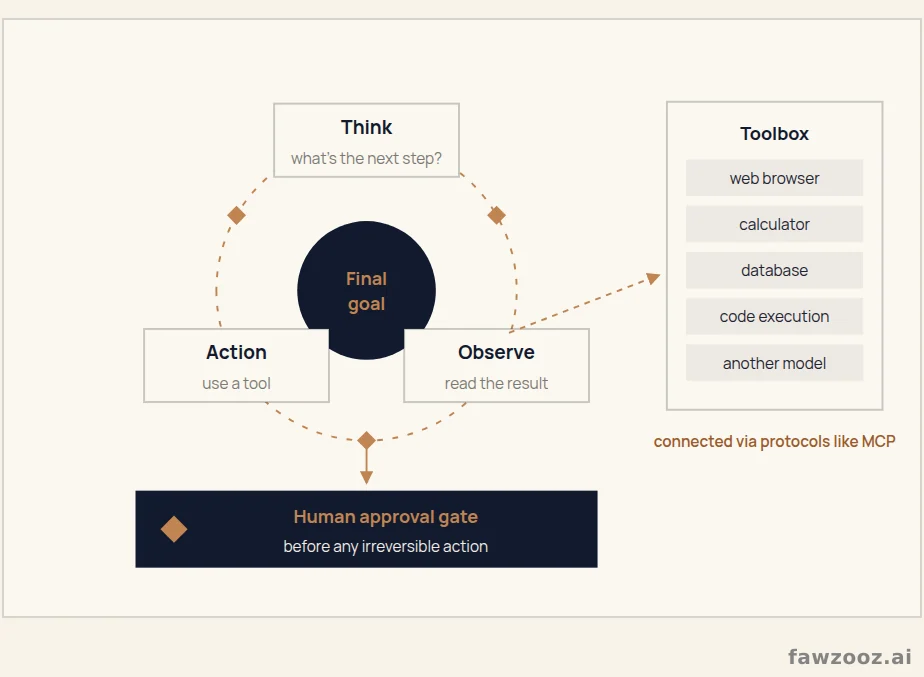
The “Reasoning Loop”: How an Agent Plans
Text in this figure
Final · goal · Think · what’s the next step? · Action · use a tool · Observe · read the result · Toolbox · web browser · calculator · database · code execution · another model · connected via protocols like MCP · Human approval gate · before any irreversible action · Figure 14
- Think: it analyzes the goal and identifies the first step: “I first need the opening hours and ticket prices.”
- Act: it picks the right tool from its “toolbox,” a browser, a calculator, a translator or another model: “I will search the museum’s official website.”
- Observe: it receives the result: “the museum opens at 10 a.m., and a student ticket costs 15 dirhams.”
- Think again: “I have the prices; now I calculate the total cost.”
- Act again: a different tool: the calculator: 20 × 15 = 300 dirhams.
The loop continues (think → act → observe): it searches bus routes, compares times, builds the schedule, and delivers the complete plan.
Components of the Modern Agent
2026 Update
Agents have matured from lab experiments into products used in companies: coding agents that write and test code, research agents that read dozens of sources and write a cited report, and agents that use a computer the way a person does, by clicking and typing. Open protocols have emerged to standardize how agents connect to tools and data, most notably the Model Context Protocol (MCP), with others for agents to communicate with each other.
- The brain: the language model that plans and reasons (Chapter 9).
- Tools: APIs, databases, a browser and code execution, each described clearly to the agent.
- Memory: short-term within the task, and long-term for user preferences and lessons from past tasks.
- Planning: decomposing the goal and revising the plan when a step fails.
- Guardrails: limited permissions, human approval before sensitive actions such as paying, sending and deleting, and a full log of every step.
From one agent to a team of agents
For large tasks, an “orchestrator agent” distributes the work among specialized agents: researcher, writer, reviewer and checker. It resembles a human team with clear roles, and like one it needs coordination rules and boundaries of responsibility.
From the Field
An agent multiplies impact and error alike. A small mistake in step one can snowball across ten steps. Start with reversible tasks, grant the least privilege that suffices, and require human approval for every action that cannot be undone. Remember that an agent reading web pages and email is exposed to “prompt injection” hidden in them (Chapter 19).
From “User” to “Manager”
Agents move us from users of software to managers of processes: we no longer manage every detail; we set the vision, the goal and the quality criteria, then monitor execution and hold it to account.
Lessons Learned
- 1AI is evolving from executing direct commands to achieving compound goals.
- 2A smart agent is an autonomous system that uses various tools to reach a goal.
- 3It works through a reasoning loop: think about the step, act with a tool, observe the result.
- 4The modern agent: brain, tools, memory, planning and guardrails, connected to the world through protocols like MCP.
- 5Our role shifts from “user” to “manager” who delegates, monitors and holds to account.
Tip: use ← → to move between sections.