

Chapter 2
02Human Intelligence and Why AI Matters
“When guided by human emotional insight, AI becomes a powerful tool for understanding, connecting with and elevating human potential.”
AI stands for “artificial intelligence,” but the term alone can obscure an important truth: not all intelligence is artificial, nor should it be. Before diving into algorithms and data, it is vital to appreciate the value of human intelligence, and why AI amplifies our innate abilities rather than replacing them.
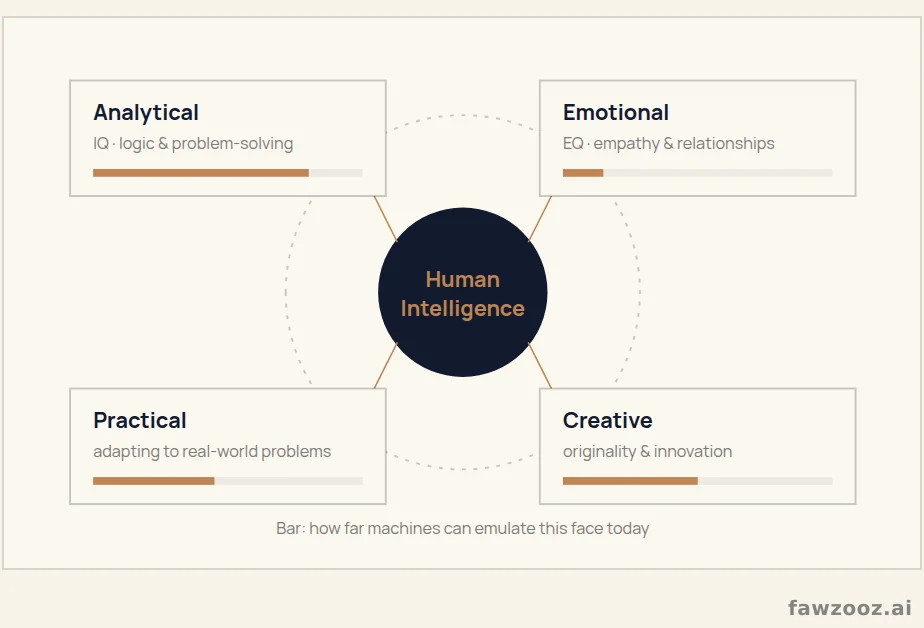
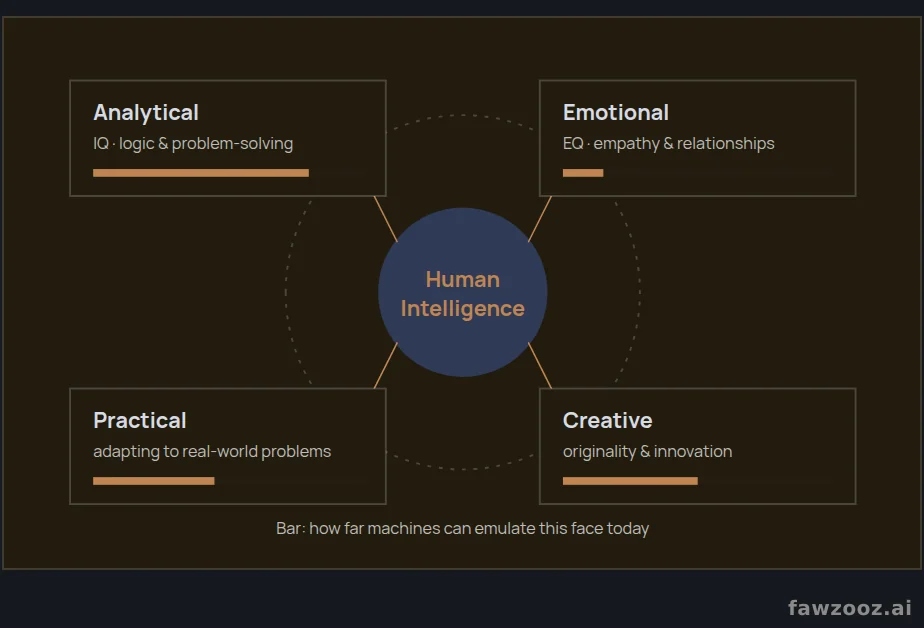
Text in this figure
Human · Intelligence · Analytical · IQ · logic & problem-solving · Emotional · EQ · empathy & relationships · Practical · adapting to real-world problems · Creative · originality & innovation · Bar: how far machines can emulate this face today · Figure 2 · * This figure was developed from concepts presented in the Post Graduate Program in AI for Leaders (UT Austin McCombs / Great Learning).
The Many Faces of Human Intelligence
Human intelligence is multifaceted, from analytical to emotional, from creative to practical. Recognizing this breadth is the first step to understanding what AI can and cannot replicate.
Analytical intelligence (IQ)
- Focuses on logic, reasoning and problem-solving; often measured by standardized tests and linked to academic performance.
- AI can mimic parts of it, such as pattern recognition and data-driven solutions, but struggles with nuanced social and emotional context.
Emotional intelligence (EQ)
- Self-awareness, empathy, motivation and managing relationships; vital in leadership, teamwork and customer-facing roles.
- AI can analyze sentiment in text and speech, but it does not experience emotions; genuine empathy and connection remain human.
Creative intelligence
- Innovation, originality and thinking outside the box.
- AI generates art, music and text by learning patterns, but the spark tied to human culture and emotional resonance still depends on human direction.
Practical intelligence
- Solving real-world problems and adapting, developed through experience and social interaction.
- AI provides data-driven insights, but the intuition to apply them effectively usually rests with people.
Synergy: the machine handles repetitive, data-heavy work, freeing people for creativity, empathy, leadership and nuanced decisions.
Where Human and Machine Intelligence Meet
Beyond automation
A common misconception is that AI exists mainly to automate jobs and replace workers. In fact, many of the most successful applications focus on augmentation: helping professionals with tasks that are tedious or error-prone.
- Healthcare: diagnostic tools analyze medical images with high accuracy, while the final judgment and compassionate care stay with the physician.
- Customer service: chatbots handle common questions, and human agents step in for complex, emotionally charged interactions.
The role of data
AI thrives on data; large, high-quality datasets let algorithms learn, adapt and predict. Humans excel at interpreting results and asking “why?” A machine may predict a stock decline from patterns, but it is often a person who spots the anomaly, such as a sudden geopolitical shift the model never learned.
Emotions as a human differentiator
Emotions guide our decisions in ways data alone cannot capture. A machine may detect sentiment in text or voice, but the ability to console, encourage and inspire remains human, and in business it is the foundation of trust with customers and teams.
Why AI Matters in the Modern World
If human intelligence is so valuable, why do we need AI? The short answer: scale, speed and efficiency.
- Managing complexity: today’s problems involve hundreds of variables and massive data, which AI processes at speeds impossible for humans, revealing hidden insights.
- Accuracy and consistency: people tire, get distracted and carry biases; a well-trained model keeps steady performance in quality control and cybersecurity anomaly detection.
- Accelerated innovation: real-time insight shortens the feedback loop between experiment and result, from product launches to supply chains.
- Augmenting human roles: by handling the repetitive, AI frees people for critical thinking, empathy and creative problem-solving.
The Evolving Landscape: AI Meets Emotional Intelligence
Future-proofing your skill set
As machines grow more capable at analytical tasks, the ability to understand and manage human emotions becomes more valuable. Emotional intelligence is your investment in the future, in:
- Leadership: inspiring and guiding teams through change.
- Communication: explaining complex decisions to stakeholders in relatable terms.
- Empathy: building products and services that fit people’s needs.
AI-assisted coaching and self-improvement
AI itself can support your emotional growth: coaching platforms analyze your spoken and written communication and offer feedback on tone, word choice and how others may perceive you. Combining your own reflection with such feedback can drive professional growth.
AI and Humanity: A Symbiotic Relationship
- Collaborative decision-making: the machine recommends from massive data, and the expert applies domain knowledge and emotional intelligence to refine the decision. Example: in financial services AI suggests strategies, while the advisor weighs the client’s goals, risk tolerance and market sentiment.
- Continuous learning: machines learn from new data, people learn from experience and interaction, and together they drive innovation from manufacturing to healthcare.
- Elevated customer experience: virtual assistants handle the routine, humans step in where empathy is needed, balancing efficiency with real connection.
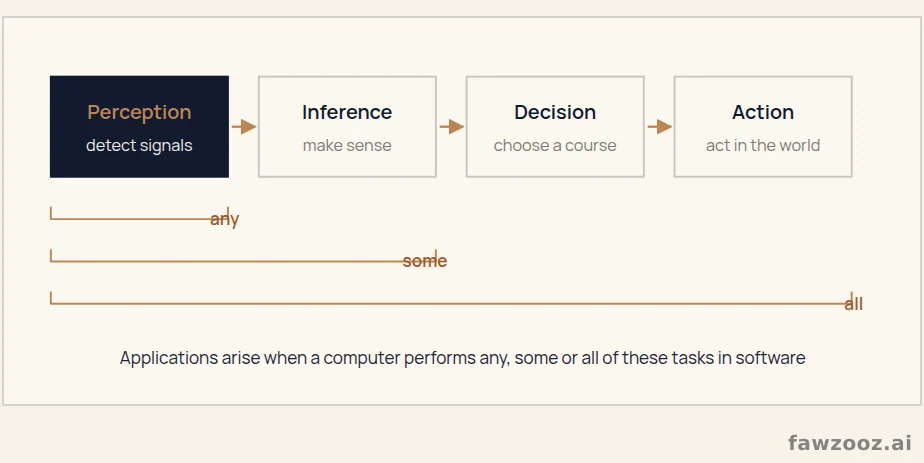
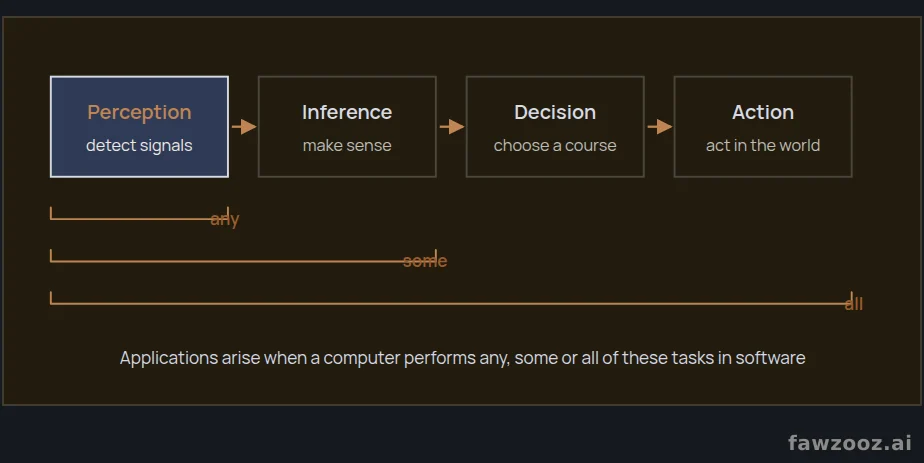
Text in this figure
Perception · detect signals · Inference · make sense · Decision · choose a course · Action · act in the world · any · some · all · Applications arise when a computer performs any, some or all of these tasks in software · Figure 3 · * This figure was developed from concepts presented in the Post Graduate Program in AI for Leaders (UT Austin McCombs / Great Learning).
2026 Update
The generative assistant has become a “colleague” in most office work: drafting first versions, summarizing meetings and analyzing spreadsheets. This raises the value of skills that cannot be automated: judgment, empathy and asking the right question.
This foundation underpins everything that follows: AI is not a substitute for human genius, but a catalyst for it when harnessed responsibly.
Lessons Learned
- 1Human intelligence is multifaceted: analytical, emotional, creative and practical; machines mimic some of it, not all.
- 2The best applications augment people rather than replace them.
- 3Emotional intelligence grows in value as machines advance in analysis.
- 4AI brings speed, scalability and consistency to manage rising complexity.
- 5Coexistence, not competition: humans and machines complement each other.
Tip: use ← → to move between sections.