

Chapter 6
06The “Creative” Mind: The Rise of Generative AI
“It no longer settles for reading every book in the world; it can now write a new one.”
For a long time, AI’s value was limited to “analysis”: understanding data, discovering patterns and predicting. It was a super-powerful analytical mind. Then a new revolution moved it from analysis to creation, and from a passive tool to an active creative partner. This is the world of generative AI.
The Power of “Foundation Models”
The engine behind this shift is the “foundation model”: giant models trained not to solve one problem, like classifying cat photos, but on vast amounts of unlabelled data, billions of texts, images and sounds. This broad knowledge base gives them a deep grasp of patterns, language and context that lets them generate new outputs.
2026 Update
Foundation models have become “multimodal,” understanding and generating text, images, audio and video together. Today they come as “closed” models used through APIs, and “open-weight” models that can be run and fine-tuned inside the organization. Smaller families now run on personal devices (Chapter 13).
Simplifying Generation: The “Artist and Critic” Analogy
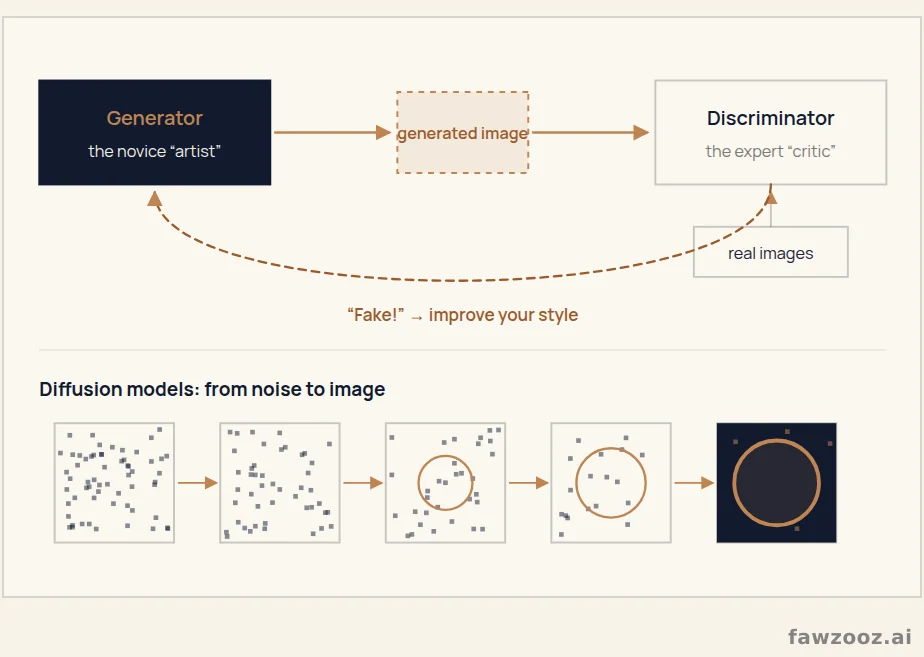
How does a machine create an image that never existed? One foundational approach, Generative Adversarial Networks (GANs), rests on an internal contest between two components:
Text in this figure
Generator · the novice “artist” · Discriminator · the expert “critic” · generated image · real images · “Fake!” → improve your style · Diffusion models: from noise to image · Figure 10
- The generator: the novice “artist”; it tries to draw a new image, at first little more than a scribble.
- The discriminator: the expert “critic”; trained on millions of real images, its job is to judge: real or fake?
- The contest: the critic catches the fakes, so the artist improves, while the critic grows sharper. After thousands of rounds the artist reaches a mastery that fools the critic itself.
Beyond Artist and Critic: Diffusion and Transformers
Generation then evolved in two directions that lead the field today:
- Diffusion models: start from random “noise,” like a static-filled TV screen, then remove it step by step guided by your text description until the image or video appears. They dominate image and video generation today.
- Generative transformers: predict the next token again and again, writing text and code, and generating audio and images once these are encoded as tokens.
- Multimodality: a single model reads an image and explains it in speech, or turns a sketch on paper into a working app.
From “Awakening Intelligence” to “Awakened Creativity”
With the rise of generative AI, “awareness” matters more than ever. The creative machine lacks three human assets:
- Heart (empathy): it does not understand the emotional and human context of what it creates.
- Vision: it has no purpose or strategic vision of its own; it only executes requests.
- Moral compass: it cannot tell right from wrong, or useful innovation from harmful.
From the Field
Generation cuts both ways: deepfakes of voice and image are now cheap to make. This is why content-credential standards and digital watermarks, including C2PA, have emerged to document an image’s origin and edit history. The aware creator discloses the use of generation and respects ownership and consent.
Learning to “steer” this creativity through prompting (Part Three) and to “secure” its outputs through responsible AI (Part Five) is the essence of moving from mere use to aware innovation.
Lessons Learned
- 1AI has become a partner that generates new content, not only an analysis tool.
- 2Foundation models trained on massive data are the engine of the generative revolution.
- 3Machines learn to create through competition (artist and critic), denoising (diffusion) and sequential prediction (transformers).
- 4The more powerful generation becomes, the more we need human awareness: empathy, vision and ethics.
Tip: use ← → to move between sections.