

Chapter 1
01Information Security Fundamentals in a World of Ideas
“When the idea is the asset, protecting it becomes part of making it.”
In the digital age, information security has become the cornerstone of operational integrity in every industry. In sectors that live on ideas, from the creative studio to the software team to the AI lab, intellectual property is the lifeblood of innovation and competition, so securing sensitive data becomes a strategic priority. This chapter sets out the core principles on which everything that follows is built.
The Three Pillars of Information Security: The CIA Triad
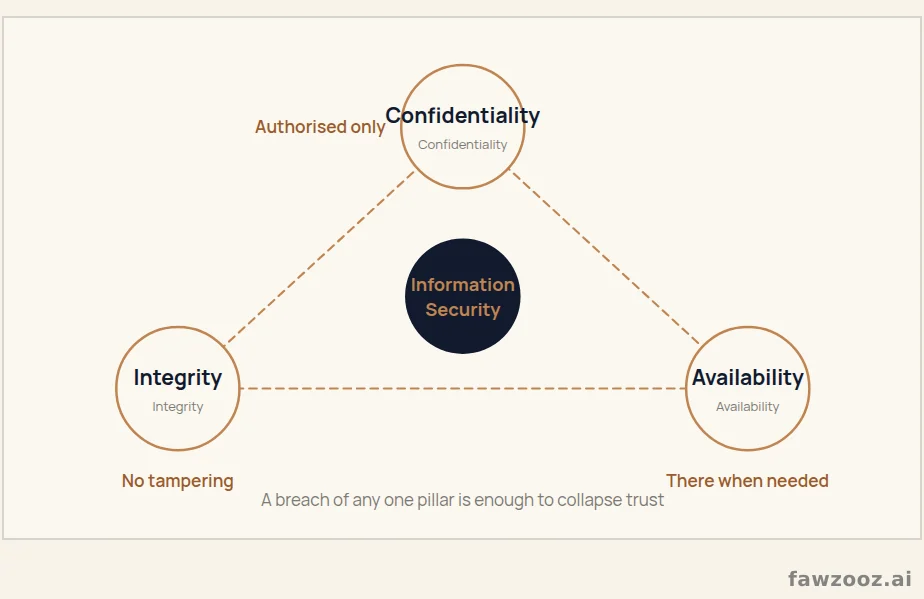
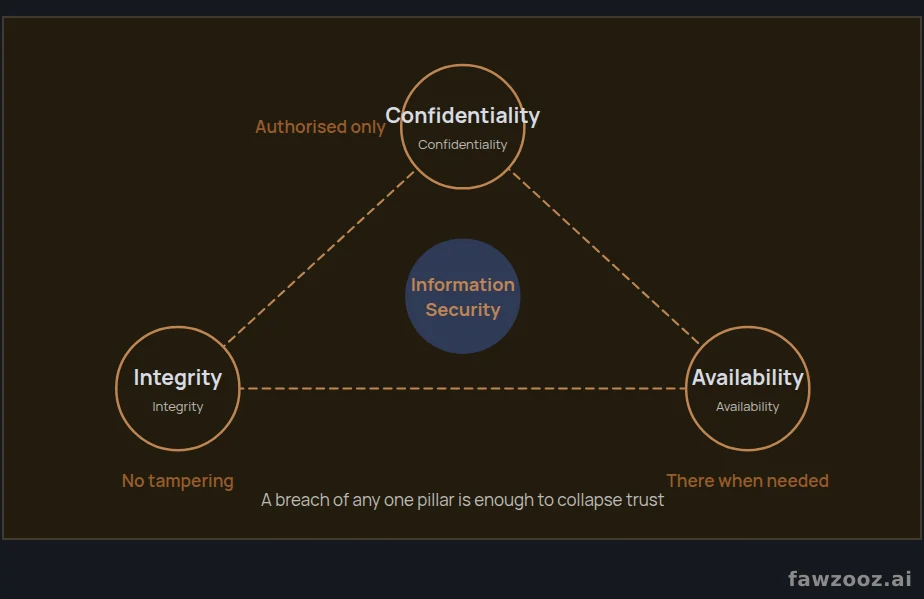
The universally recognised model of information security is the CIA triad: Confidentiality, Integrity and Availability. These three principles form the foundation of any robust security programme, and every control in this book serves one or more of them.
Text in this figure
Information · Security · Confidentiality · Confidentiality · Authorised only · Integrity · Integrity · No tampering · Availability · Availability · There when needed · A breach of any one pillar is enough to collapse trust · Figure 2
- Confidentiality: Information is available only to those authorised. It protects new designs, unpublished scripts, confidential project details and client information. A film script leaked before release can spoil the plot for audiences and hurt the box office, and early disclosure of a product design hands competitors an unfair advantage.
- Integrity: Information is protected from unauthorised modification and stays accurate. Imagine a digital artist’s work being subtly altered without their knowledge, or a client’s brand guidelines being tampered with so that incorrect, damaging marketing material goes out. In software, a single injected line of code can open a backdoor for years.
- Availability: Information and resources are accessible to authorised users when needed. A denial-of-service attack on a design agency’s servers, or ransomware encrypting all of a photographer’s files, can halt work entirely, costing deadlines, money and reputation.
Why Information Security Matters to the Creative Process
A strong security framework is not only about meeting legal and regulatory requirements; it strengthens the creative process itself. A secure environment fosters a culture of trust and collaboration, where team members feel safe sharing ideas and experimenting without fear of theft or compromise. That psychological safety is a powerful driver of innovation.
Security measures also protect the company’s brand and reputation. At a time when data breaches make headlines, a company that demonstrates its commitment to security earns and keeps client trust, and this is especially true in the creative industries, where clients often entrust agencies with sensitive and valuable information.
Unique Security Challenges in the Creative and Software Industries
- Project churn: Teams form and dissolve with every project, so access is hard to manage and old access often stays open after the work ends.
- Extensive external collaboration: Freelancers, contractors and partners raise the risk of data leakage if the relationship is not tightly managed.
- Sheer data volume: From high-resolution video to 3D models and code repositories, comprehensive data management becomes complex.
- Release speed: Deadline pressure pushes teams to shortcut reviews, and security is the first thing cut.
2026 Update
Generative AI has added a fifth challenge: client files and project secrets are now pasted into public AI tools with a single click. The “prompt” has become a new leakage channel, and models, prompts and agents have become assets that need protecting just like code and design.
Understanding these principles and challenges is the first step towards a secure framework that ensures creativity not only survives but thrives. In the chapters that follow, we dive into the standards that turn these principles into a system that can be built, measured and improved.
Lessons Learned
- 1The CIA triad is the common language of every security decision.
- 2In creative environments, security enables innovation because it gives the team confidence.
- 3Project churn, external collaboration and data volume are particular challenges that need controls designed for them.
- 4Prompts and models are new assets on the list of what must be protected.
Tip: use ← → to move between sections.