

Chapter 20
20AI Risk and AI System Impact Assessment
“Assess the risk to your organisation, then assess the impact on people; they are not the same question.”
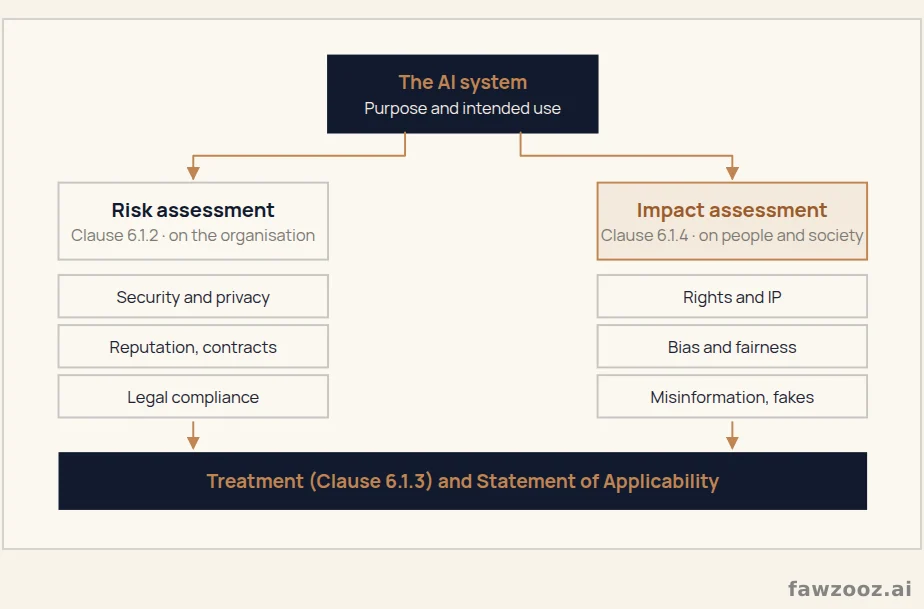
The heart of ISO 42001 is Clause 6, where it differs from 27001 through two complementary processes: AI risk assessment (6.1.2) and treatment (6.1.3), and AI system impact assessment (6.1.4). The first looks at the organisation and its objectives; the second looks at individuals and society.
Text in this figure
The AI system · Purpose and intended use · Risk assessment · Clause 6.1.2 · on the organisation · Security and privacy · Reputation, contracts · Legal compliance · Impact assessment · Clause 6.1.4 · on people and society · Rights and IP · Bias and fairness · Misinformation, fakes · Treatment (Clause 6.1.3) and Statement of Applicability · Figure 26
AI Risk Assessment
It follows the same methodology we already know: identify, analyse, evaluate and treat. But the risk sources are wider, and Annex C suggests examples:
- Data: Its quality, representativeness, right of use, and poisoning.
- Model: Insufficient performance, drift over time, and difficulty of explanation.
- Automation: The level of autonomy, and absence of human oversight where needed.
- Environment: Using the system in a context it was not designed for.
- Security: Adversarial attacks, prompt injection and model theft.
- Technology and supplier: Dependence on an external model that changes without notice.
Risks are treated with the same four options, then the chosen controls are compared with Annex A of 42001 and a dedicated Statement of Applicability is prepared, just as in 27001.
AI System Impact Assessment
This is what is truly new. Before launching a system, or when changing it significantly, the organisation assesses its potential consequences for individuals, groups and society: does it deprive anyone of an opportunity? Does it mislead? Does it touch privacy, dignity or property rights? The results are documented and taken into account in the risk assessment.
| Area | Guiding question |
|---|---|
| Purpose | What is the task? Which uses are explicitly prohibited? |
| Affected parties | Who is the user? Who is touched by outputs? Are vulnerable groups among them? |
| Data | Where does it come from? Do we have the right to use it? |
| Impacts | Bias? Misinformation? Harm to privacy or ownership? |
| Controls | Human oversight? Disclosure? Usage limits? |
| Decision | Launch, conditional launch, redesign, or stop. |
From the Field
A campaign image generator that shows only one type of face is not a small technical bug; it is an impact on the image of an entire audience, and can become a reputational crisis for the client in a single day.
AI Objectives
Clause 6.2 requires measurable objectives for responsible AI, such as: “100% of high-impact systems have an approved impact assessment before launch”, “human review of all generated content published in the client’s name”, or “halve complaints about inappropriate outputs within a year”. Annex C suggests objectives such as accountability, fairness, privacy, robustness, safety and transparency.
Impact assessment protects the people who are not sitting with you in the meeting room.
Lessons Learned
- 1Risk assessment looks at the organisation; impact assessment looks at people.
- 2AI risk sources include data, model, automation and environment.
- 3Impact assessment is carried out before launch and after every significant change.
- 4Responsible AI objectives are as measurable as security ones.
Tip: use ← → to move between sections.