Chapter 01
01Seeds of Innovation
1.1More Than Machines
Some of the most important things in life are never seen. Trust. Safety. Peace of mind. They exist quietly in the background, allowing people to move forward without hesitation. The same is true of the digital world. Every secure system and every intelligent technology that people use with confidence is supported by countless decisions made behind the scenes. I have devoted my career to building that invisible foundation. My work has centred on creating secure, responsible AI systems that place people at the heart of technological progress. Although the results of that effort may not always be visible, they shape how institutions operate and how individuals interact with technology every day.
“Engineer invisible resilience to protect human will” — at the intersection of human intelligence and machine autonomy. For me, that phrase reveals a lifelong commitment to preparing for challenges before they appear, and to designing systems people can rely on with confidence. Behind every professional achievement stands a deeply personal purpose. Much of that purpose comes from family. Thinking of my children, and especially my young daughter, has been a constant reminder that the technologies we create today will become the world the next generation inherits. Family has always remained an important source of strength. Among those who shaped my outlook, my mother holds a special place. The sense of connection she nurtured created a foundation that has stayed with me at every stage of life.
These words embody the purpose that runs through every chapter of my life. They speak of a future built with care. One idea has remained at the heart of my work throughout my career. I call it Invisible Engineering. It is the belief that the best technology does not need to demand attention. Instead, it works quietly in the background, removing obstacles and creating trust without interrupting the lives of the people it serves. The rapid rise of artificial intelligence shifted the focus from protecting machines to protecting the people who use them. That realisation marked an important turning point. My attention moved towards safeguarding human judgement in a world where intelligent systems increasingly influence daily life. That vision inspired my development of the Unified Cognitive Security Maturity Model, a framework that reflects my belief that the future of security lies in preserving human will alongside technological progress.
1.2The Spark of Curiosity
I was born in Egypt and grew up in a village in the Dakahlia governorate, where life was simpler than it is today, and more honest. There I learned the first things that are never taught: the value of effort, the generosity of neighbours, and that a person is measured by what they give rather than what they own. It all began in that village, where the tools were few and the curiosity had no limits.
Long before artificial intelligence and cybersecurity became part of my world, I was a small boy with a different kind of curiosity. I was fascinated by anything that ran on wires and electricity. Household appliances were not objects to me; they were puzzles waiting to be solved. My curiosity never stopped at observation. If something could be opened, I wanted to know what was inside. Radios, small appliances, and electronics became my playground, to the concern of everyone around me. Every screw I removed revealed another mystery, and every circuit invited another question. One afternoon, an old television set caught my attention. Convinced that I could repair it, I carefully dismantled the enormous machine and began examining its components.
What I did not expect was the charge still trapped inside. In an instant, a powerful electric shock threw me backwards and left me on the floor. For many children, that moment would have ended the experiment. For me, it was only an interruption. Once the initial shock passed and the dust settled, my attention returned to the television. The accident did not weaken my curiosity; it strengthened my determination to understand why it had happened. That childhood moment revealed a trait that would stay with me for life: obstacles never discouraged me from learning.
Years later, that same curiosity found a new purpose. Instead of examining wires and circuits, I began exploring the invisible systems that shape the modern world. The desire to understand what lies beneath the surface eventually guided me towards the research that would define much of my career. Engineering demanded precision, but I discovered early that precision alone was not enough. Real understanding came from asking deeper questions and refusing to settle for the obvious answer. That mindset became plain to see during my preparatory year.

1.3Raising the Standard
A solid-state engineering assignment asked students to submit a research paper. While many treated it as another academic exercise, I approached it differently. I spent hours reading and refining every section until I was convinced that each idea rested on solid ground. The paper was submitted, and university life continued. Then came the lecture I will never forget. The hall was full when the professor paused mid-session and called my name. Unsure of what was coming, I stood while dozens of curious faces turned towards me. The professor held up my paper and explained that it was the only submission that met the standard he had hoped to see. Turning to the rest of the class, he encouraged them to study my work if they wanted to understand how research should be approached and presented. That experience raised the standard I set for myself.
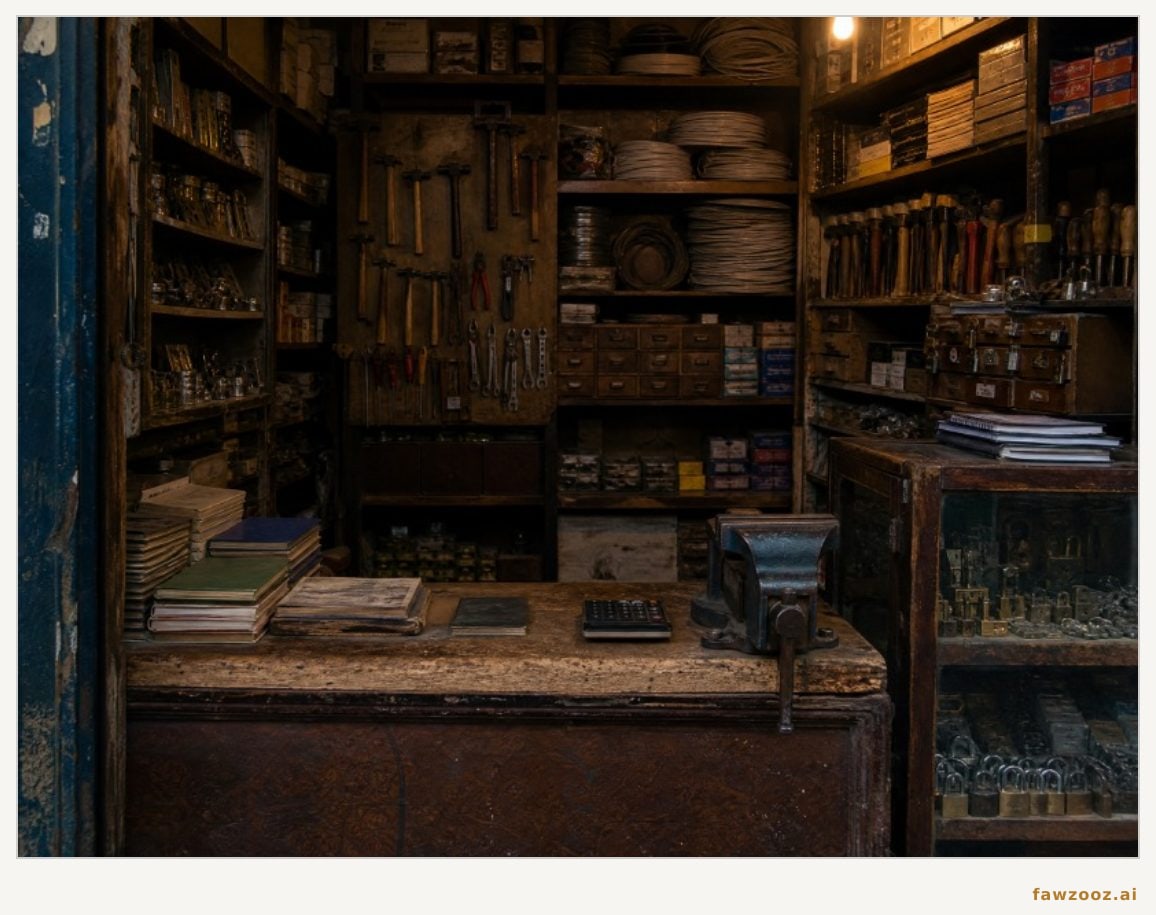
The final school bell did not mark the end of my day. While my classmates headed home to rest or spend time with friends, I made my way to my father’s hardware shop. There, a different kind of classroom was waiting. Shelves of tools and electrical supplies replaced blackboards. Customers, with their questions and requests, became part of my afternoon routine. As the shop filled with activity, I spent my time either solving engineering problems or preparing for an upcoming exam. It was a rhythm that repeated day after day, leaving little room for distraction. Balancing work and education required the ability to give my full attention to whatever stood in front of me. Without realising it, those evenings in the shop were preparing me for the years ahead. The habit of moving between practical challenges and complex ideas would later become second nature.
1.4Curiosity as a Compass
Unlike many who can point to a single teacher or mentor, my path unfolded differently. My greatest mentor was a curiosity that refused to leave questions unanswered. Whenever I met an unfamiliar concept, I searched until I understood it. Books became my companions, and classrooms never felt separate from the world outside. Every lesson answered a question I had begun asking long before entering the lecture hall. Mathematics appealed to my sense of order; there was comfort in knowing that every equation follows a clear path and every solution rests on sound logic. Physics and chemistry brought those
numbers to life, explaining why currents flow, why materials behave differently, and why the devices that impressed me worked the way they did.
As technology advanced, two subjects captured my imagination more deeply. Programming offered the pleasure of creating something from nothing but logic and ideas; a few carefully written lines of code could solve problems, automate tasks, and bring complex systems to life. Networking opened another world entirely: invisible connections linking people, devices, and information, allowing them to work as one coordinated system. I found that remarkable. The most powerful networks were not necessarily the ones that drew attention to themselves; their value lay in the way everything worked together seamlessly behind the scenes.

1.5From Ideas to Innovation
As graduation approached, my team and I faced a challenge. The Faculty of Engineering wanted to turn an existing set of standalone interactive boards into a smart laboratory. The devices were already there, but each one operated independently. The task was to find a way to connect them into a single interactive environment that students and faculty could use easily. This was exactly the kind of problem that captured my imagination. My colleagues and I spent countless hours debating ideas, testing possibilities, refining our approach, and solving one obstacle after another. Our solution became the Interactive Tablet and Board Management System (TLMS). When the project was finally deployed, the transformation was striking: a collection of separate devices now worked together as one coordinated system. The university recognised the project’s success, but for me, the greater reward was watching an idea move beyond the drawing board and become part of everyday learning.
While many students were content to learn technology in the classroom, I wanted to build something I could genuinely call my own. I set myself a challenge few of my peers would have considered: instead of relying on ready-made website builders or existing templates, I decided to create a personal website from scratch. Every stage of the process became part of the experience; I designed the pages, wrote the code, configured the server, and learned how each component worked together to keep the site running. The work demanded patience, and there were moments when a small error could bring everything to a halt. I spent hours tracing bugs, and every problem solved revealed another layer of how the internet works behind the scenes.
The day the site finally went live brought a sense of accomplishment that was difficult to describe. It was more than seeing my work appear on a screen; it was the realisation that I had built an entire digital environment with my own hands and understood every part of how it functioned. That project never became a closed chapter; over the years, I continued to maintain and develop my website, treating it as a personal laboratory where I could explore and test new ideas. It kept me connected to the fundamentals of technology, reminding me that every complex system is built on countless small parts working together with precision.
1.6A School of Discipline: Reserve Officer
After graduating from the Faculty of Engineering at Mansoura University, I joined military service as a reserve officer. Those years were not an interval between two phases of my career; they were a school in their own right. There I learned discipline in its practical sense: that time is sacred, that the smallest detail leaves a mark, and that commitment is not a slogan but a daily habit built through repetition. It is a lesson that still organises the way I work today.
Inside the military institution I also found a genuine space for innovation that I had not expected. I took part in a number of development projects, and the one closest to me was a system for controlling buildings over telephone lines using dial tones (DTMF), so that systems could be operated and controlled remotely without the need for new infrastructure. It was a simple idea on the surface, but it solved a real problem with the smallest available means — and that is precisely what made me realise that innovation is not a stage that ends when the uniform comes off, but a habit of mind that travels with you to every post. It travels with me still.
I also learned leadership and people management: how tasks are distributed, how trust is built, and how a team of people from different backgrounds becomes a single unit that knows its purpose. I took part in work to turn harsh desert areas into habitable environments, and in equipping halls with audio and video systems — and the purpose behind all of it was one and the same: to make a place fit for human beings to be in. There, a conviction took root that I have carried into every project since: technology has no value unless it makes people’s lives easier.
Then came the revolution of the twenty-fifth of January, and I took part in securing critical facilities at a time when every decision carried a price and every hour counted. It was a harsh and honest experience at once, and it taught me the meaning of responsibility when it is real rather than theoretical. I received a commendation for that period and was awarded the Medal of Distinction — and its deepest effect on me lies not in the medal itself, but in the certainty that what you do in the difficult moments is what defines who you are.
When I look today at the road that began in a small shop, passed through university halls, and then through the field, I find a single thread running through all of it: a restless curiosity, and the wish that whatever passes through my hands should work better. If I could sit across from that small boy who once spent long evenings balancing homework against responsibilities in his father’s shop, I would not ask him to slow down. I would simply widen his view:
“Do not focus only on securing machines. Prepare to secure the minds that use them.”
Those words capture a lifetime of growth. My fascination with circuits gradually became an understanding that technology has value only to the extent of the people it serves. The foundations of my character were built through a curiosity that never faded, and those qualities became the compass that guided every chapter that followed. I will continue — the same small boy who once searched for answers inside a television set — to look for better ways to empower people through technology. The place will change, but the purpose will remain the same.
Tip: use ← → to move between sections.