

Section 4
4Evidence from Practice
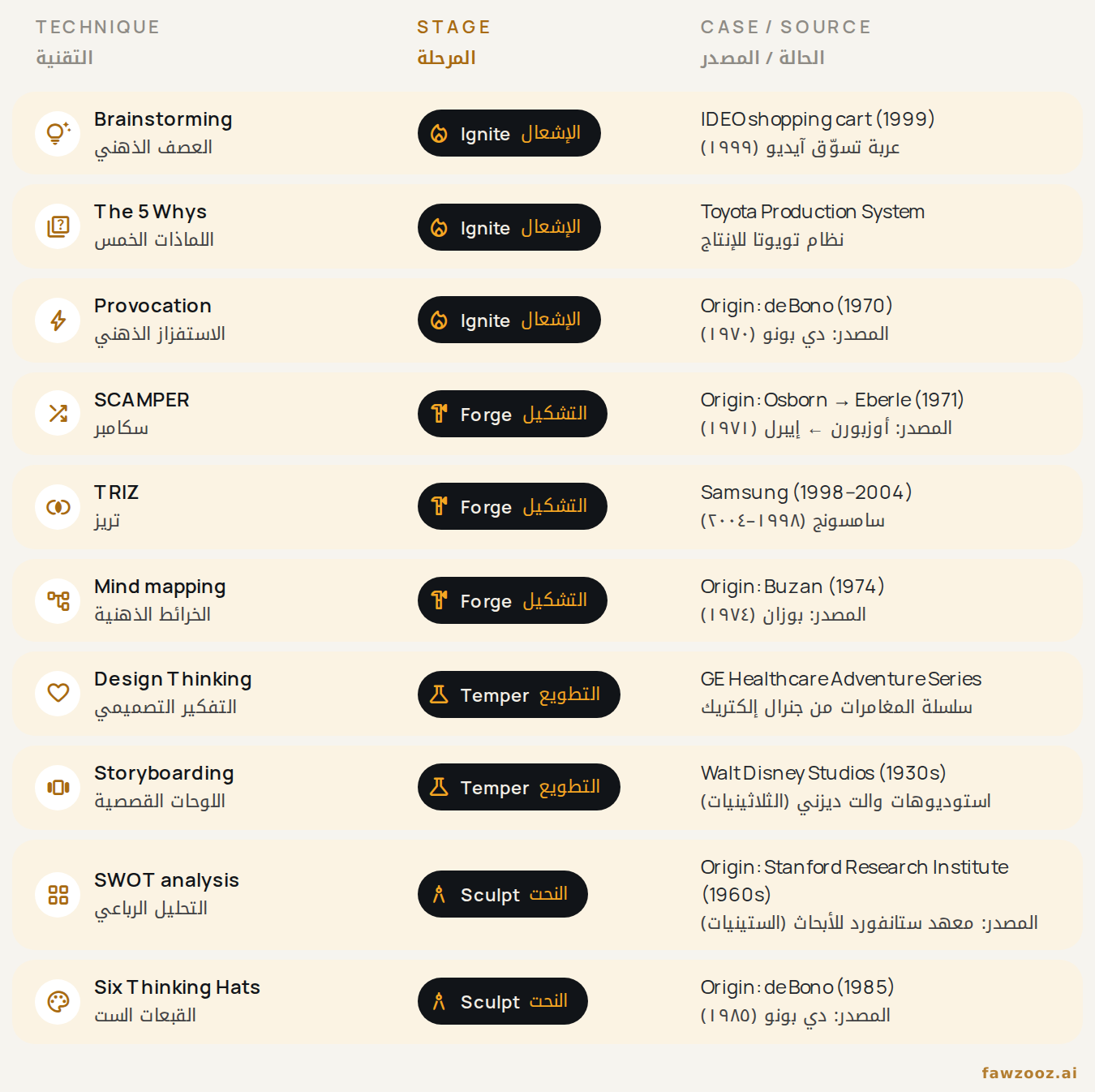
The framework draws on ten established creative techniques. Figure 2 places each one at the stage where it does its best work, alongside a documented case or its originating source. Selected cases follow.
Text in this figure
Technique · Stage · Case / source · Brainstorming · Ignite · IDEO shopping cart (1999) · The 5 Whys · Ignite · Toyota Production System · Provocation · Ignite · Origin: de Bono (1970) · SCAMPER · Forge · Origin: Osborn → Eberle (1971) · TRIZ · Forge · Samsung (1998–2004) · Mind mapping · Forge · Origin: Buzan (1974) · Design Thinking · Temper · GE Healthcare Adventure Series · Storyboarding · Temper · Walt Disney Studios (1930s) · SWOT analysis · Sculpt · Origin: Stanford Research Institute (1960s) · Six Thinking Hats · Sculpt · Origin: de Bono (1985)
Ignite · The 5 Whys
Toyota: asking “why?” five times
Taiichi Ohno made the 5 Whys a pillar of the Toyota Production System. His own example: a machine stopped because a fuse blew; the fuse blew because a bearing was not lubricated; the pump was not pumping; its shaft was worn; and metal scrap had entered because there was no strainer. The fix was a strainer, not a new fuse. The finding: define the root cause before funding a solution (Ohno, 1988).
Forge · TRIZ
Samsung: contradictions into patents
Samsung began piloting TRIZ in 1998, bringing in Russian TRIZ specialists, then trained engineers across its divisions. The company reported about 50 new patents from TRIZ projects in 2003, and a single DVD pick-up project in 2004 was credited with savings of over US$100 million. TRIZ training became expected for advancement. The finding: a systematic method, taught at scale, turns concept work into measurable output.
Temper · Design Thinking
GE Healthcare: the Adventure Series
Designer Doug Dietz saw a child in tears before a scan in an MRI machine he had designed; up to 80% of young children needed sedation to be scanned. Using design thinking with children and hospital staff, his team reframed the machine as a pirate ship or a spaceship. Sedation requests fell sharply, and patient satisfaction scores rose 90% (Kelley & Kelley, 2013). The finding: early user contact changes what gets built.
Ignite · Brainstorming
IDEO: the shopping cart in five days
In 1999, ABC’s Nightline challenged the design firm IDEO to redesign the supermarket shopping cart in five days. The team observed shoppers, ran rules-based brainstorms (defer judgment, build on others’ ideas, go for quantity), voted on ideas and built a working prototype by the deadline. The finding: structured brainstorming plus fast prototyping compresses months into days (Kelley, 2001).
Scaling: lessons from four organizations
- LEGO. Invited its community to propose and vote on new sets, and diversified into games, film and education.
- Spotify. Moved music from ownership to streaming and used data for personal discovery.
- Tesla. Innovated across product, direct sales and business model at once.
- Pixar. Protects story and culture, treating failure as a step forward.
Tip: use ← → to move between sections.