

Section 04
4From Passive Monitoring to Automated Actuation
The integration of encapsulated telemetry transforms the network from a static routing framework into an active defense mechanism. The embedded sensors establish behavioral baselines — file integrity monitoring, process lineage, and authentication patterns — continuously validating that a node's actions align with its authenticated identity.
Text in this figure
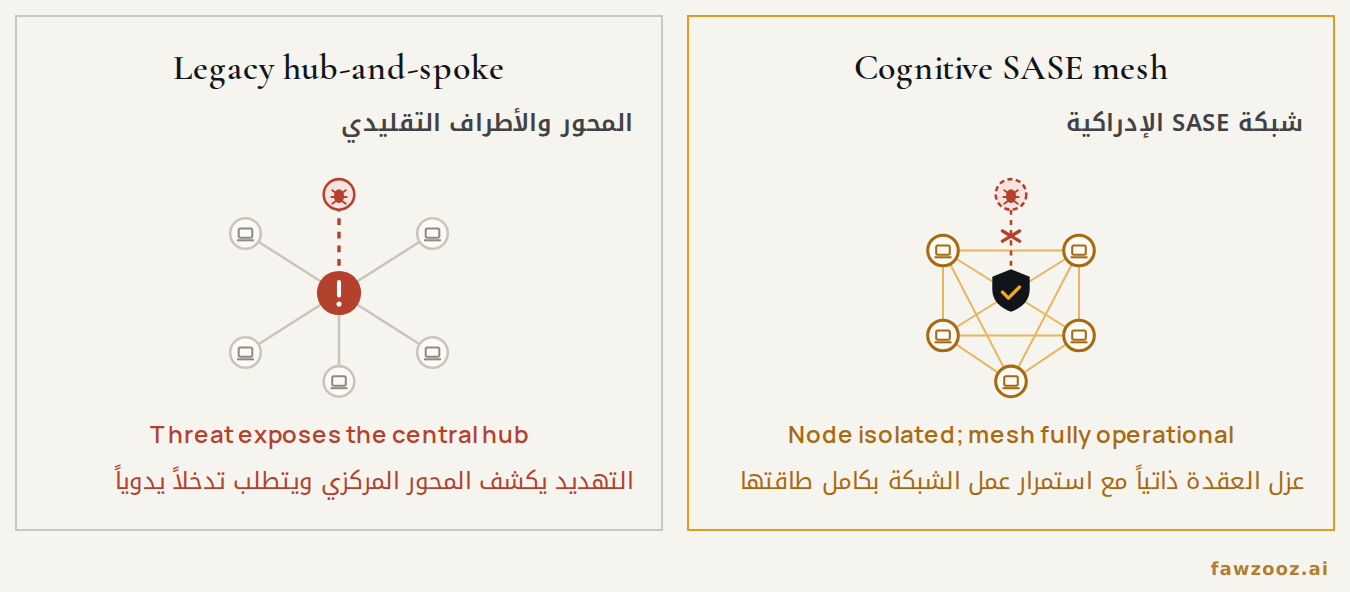
Legacy hub-and-spoke · Threat exposes the central hub · Cognitive SASE mesh · Node isolated; mesh fully operational
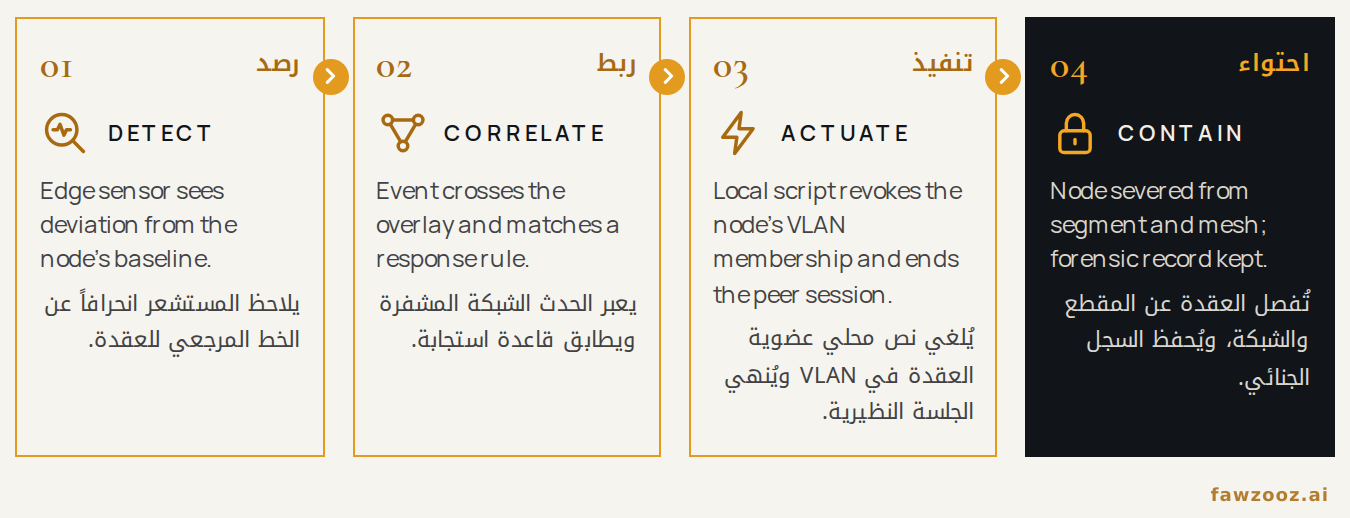
When anomalous behavior is detected, the system transitions from passive logging to active actuation. The SIEM executes localized response scripts at the edge to drop a compromised node's VLAN membership or revoke its peer session, isolating it without waiting for human intervention and without dependence on centralized firewall updates that may themselves be unreachable.
Text in this figure
DETECT · Edge sensor sees deviation from the node's baseline. · CORRELATE · Event crosses the overlay and matches a response rule. · ACTUATE · Local script revokes the node’s VLAN membership and ends the peer session. · CONTAIN · Node severed from segment and mesh; forensic record kept.
Tip: use ← → to move between sections.